Pentax 17 Half-Frame Film Camera In-Depth Review: The First All-New Film Camera from a Major Manufacturer in a Decade – Is It Worth Buying?
In an era dominated by digital photography, film has made a resilient return to the mainstream. However, past discussions of a "revival" often pointed to long-d
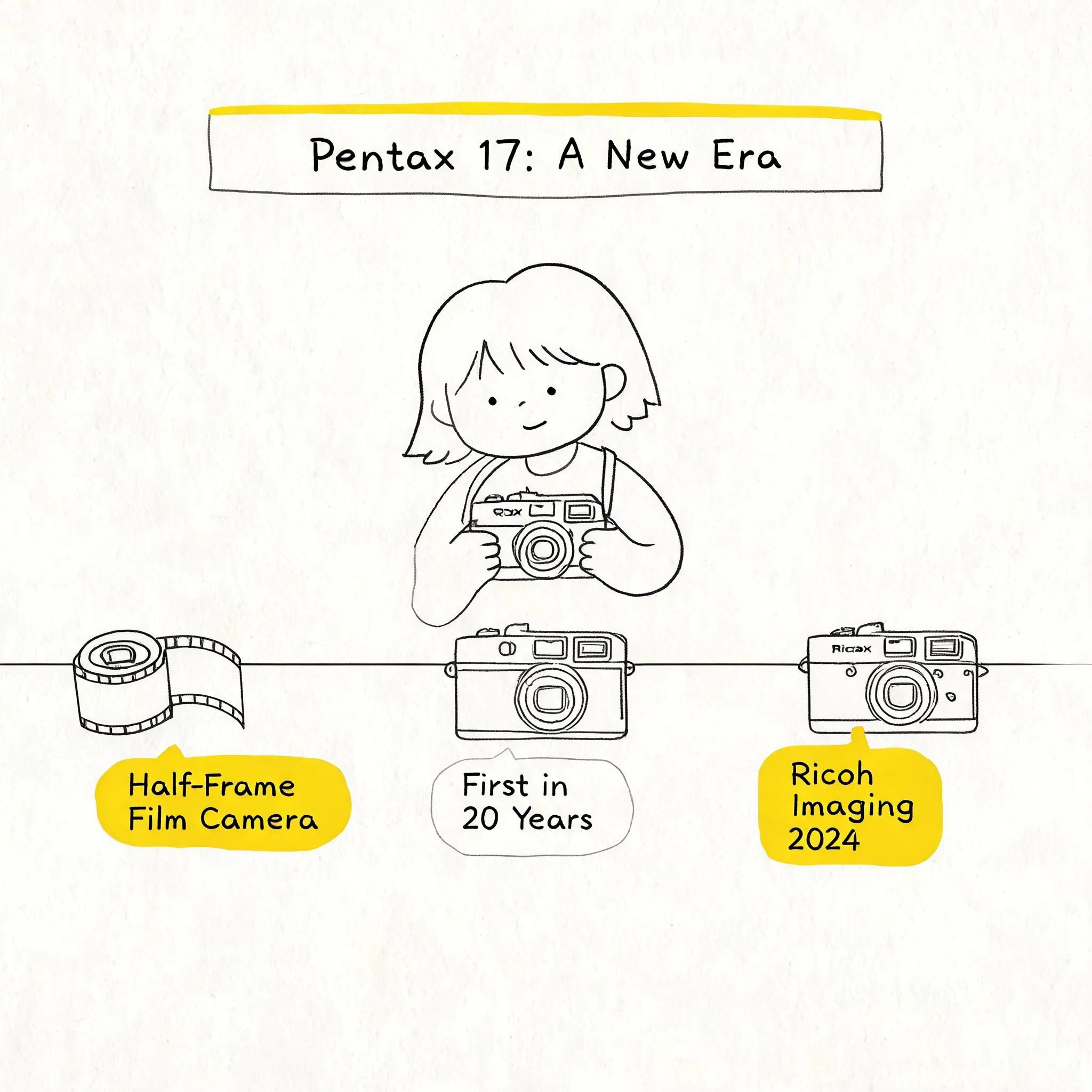
In an era dominated by digital photography, film has made a resilient return to the mainstream. However, past discussions of a “revival” often pointed to long-discontinued classic models or rebranded “new wine in old bottles.” It wasn’t until 2024 that Ricoh Imaging’s Pentax brand officially launched the Pentax 17—a completely new, forward-looking half-frame film camera designed from the ground up. This is not only the result of the Pentax Film Project but also the first all-new film camera design from a major manufacturer in the past two decades, rather than a reissue or rebrand .
Since its announcement, the camera has been surrounded by significant attention and controversy: Can it redefine the entry-level film photography experience in the digital age? How does its brand-new 25mm prime lens perform? And what does the “half-frame” format, which sounds somewhat retro, mean today? This review sets aside nostalgic filters and conducts a thorough real-world evaluation of the Pentax 17 across five core dimensions: image quality, focusing, handling, the half-frame experience, and value for money. It aims to help you determine whether this “once-in-a-decade” new camera from a major brand is worth your investment.
Half-Frame Format: The Economics of 72 Shots per Roll and a Composition Revolution
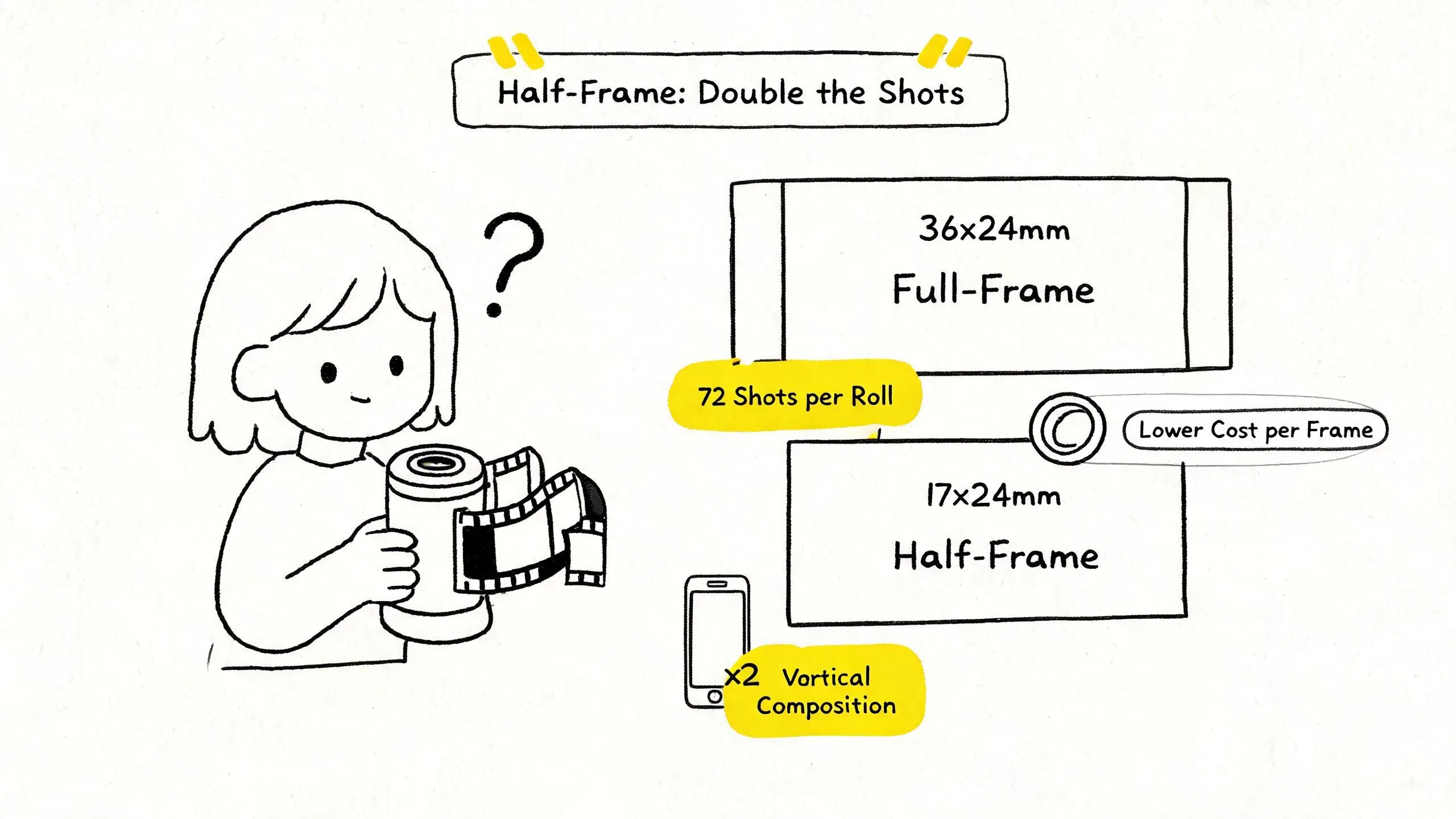
Before diving into the details of the Pentax 17, we must first understand its core feature—the half-frame format. A standard 135 film frame measures 36×24mm, while the Pentax 17’s frame is 17×24mm, halving the width. The “17” in its name refers to this film width . This means a standard 36-exposure roll can yield 72 half-frame photos.
This first brings a significant boost in economy. With film prices continually rising, the same budget now provides double the number of shots. For beginners, travel documentarians, or anyone looking to reduce the cost per image, this is undeniably attractive.
A deeper impact lies in the shift in compositional thinking. The half-frame camera’s default vertical orientation has an aspect ratio (approximately 3:4) strikingly similar to today’s smartphone screens. This naturally guides photographers toward vertical compositions, contrasting sharply with the horizontal-first habit of traditional 135 cameras. It forces you to rethink the arrangement of elements in the frame, potentially sparking fresh visual inspiration. Of course, you can rotate the camera for horizontal shots, but vertical is its “comfort zone.”
Body Design and Handling: Modern Logic in a Retro Shell
The Pentax 17’s design is steeped in retro charm, yet its core logic is optimized for modern users. The top and bottom plates are made of magnesium alloy, with the rest in plastic, resulting in a solid build. It weighs approximately 290g without battery or film and measures 127×78×52mm, offering a moderate grip .
Core controls are concentrated on the lens barrel and top plate. Above the lens is the iconic zone focusing dial, which sets the focus distance by rotating to select different icon positions. Below the lens correspond meter/feet scales for precise reference . The top-plate shooting mode dial offers seven modes, including Auto, Program Auto without flash (white P), Slow-speed without flash (white moon), Maximum Aperture Priority without flash (white BOKEH), Bulb (white B), and two Program Auto/Slow-speed modes with flash . This physical separation of focusing and shooting modes is logically clear and quick to learn.
Manual film advance is the soul of the Pentax 17’s retro experience. The resistance and “click” of the advance lever provide a mechanical ritual scarce in the digital age. However, multiple reviewers note a shutter lag of about half a second from half-pressing the shutter to actual capture, which requires adaptation .
The viewfinder is a highlight. It uses an Albada bright-frame optical viewfinder, offering a clear and bright view with built-in close-range parallax correction frames. Compared to the Kodak Ektar H35N, its viewfinder is significantly clearer and brighter . The viewfinder displays the current focus zone icon in real-time, and blue and orange indicator lights on the right warn of issues like the lens cap being attached, film not advanced, or low battery, which is very practical .
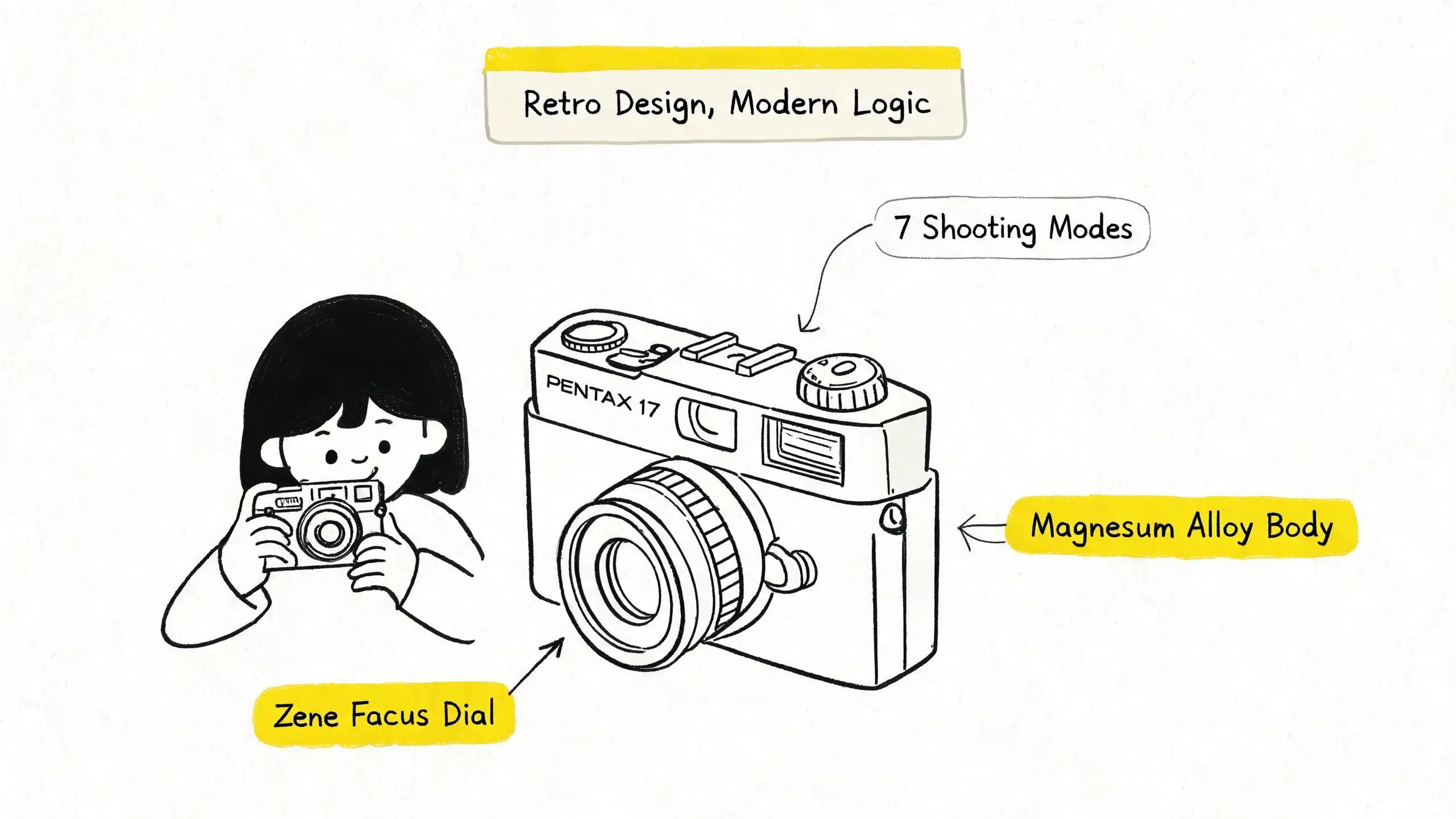
Image Quality Test: The Real-World Performance of the HD-Coated 25mm Prime Lens
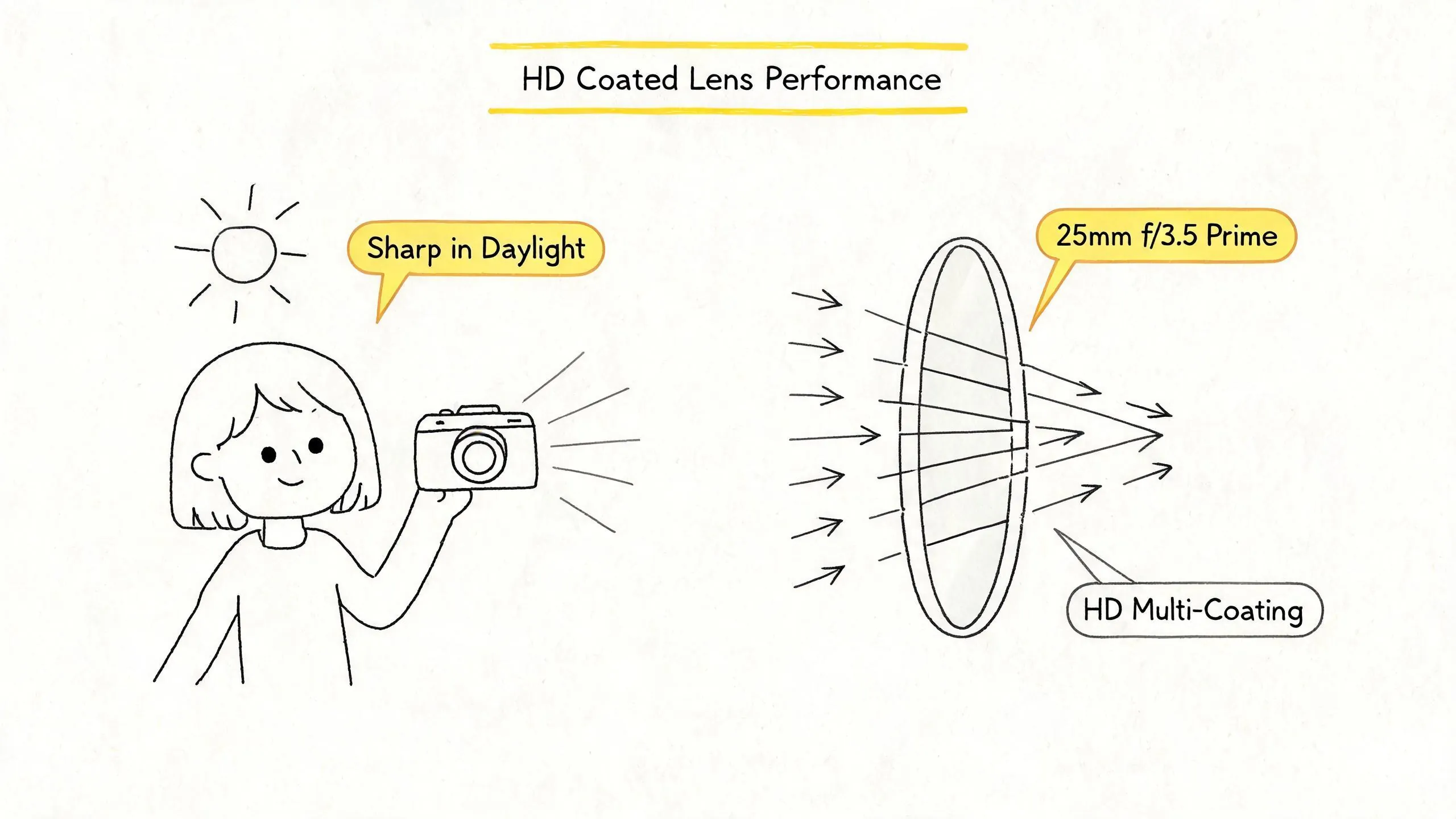
Image quality is central to a camera’s value. The Pentax 17 features a newly developed 25mm f/3.5 prime lens, equivalent to a classic 37mm perspective on 35mm full-frame. Its optical design is a 3-element triplet, inspired by the 1994 Pentax Espio Mini and the 1962 RICOH Auto Half . Crucially, this lens incorporates HD Coating (High Definition multi-layer coating) and SP Coating (Super Protect water- and oil-repellent coating) used in Pentax SLR lenses—a rarity in cameras at this price point .
How does it perform in practice? We tested it with ISO 200 daylight film, ISO 400 all-purpose film, and ISO 800 high-speed film under various lighting conditions.
- Daylight: This is the Pentax 17’s best stage. The lens delivers excellent sharpness, producing clear images even with grainier ISO 400 film. Color reproduction is accurate, contrast is moderate, and thanks to the HD coating, there is no significant flare or ghosting . DPReview’s assessment is fair: image quality is comparable to typical high-quality point-and-shoot film cameras, which is a reasonable and impressive performance considering the half-frame format .
- Overcast and Indoor: In slightly dimmer light, the lens’s f/3.5 maximum aperture provides usable light intake. The metering system is accurate, and with ISO 400 or 800 film, properly exposed photos are achievable. Moment’s review notes that photos are sharp in bright light, with pleasing grain and vintage colors . 35mmc gave it a high score of 4.5/5 .
Overall, this lens’s quality far surpasses disposable cameras and many cheap half-frame cameras. The flare resistance from its coating and the solid overall imaging are the Pentax 17’s core competitive advantages in terms of image quality.
Focusing Accuracy and Zone Focus in Practice: Is the Seven-Zone System Reliable?
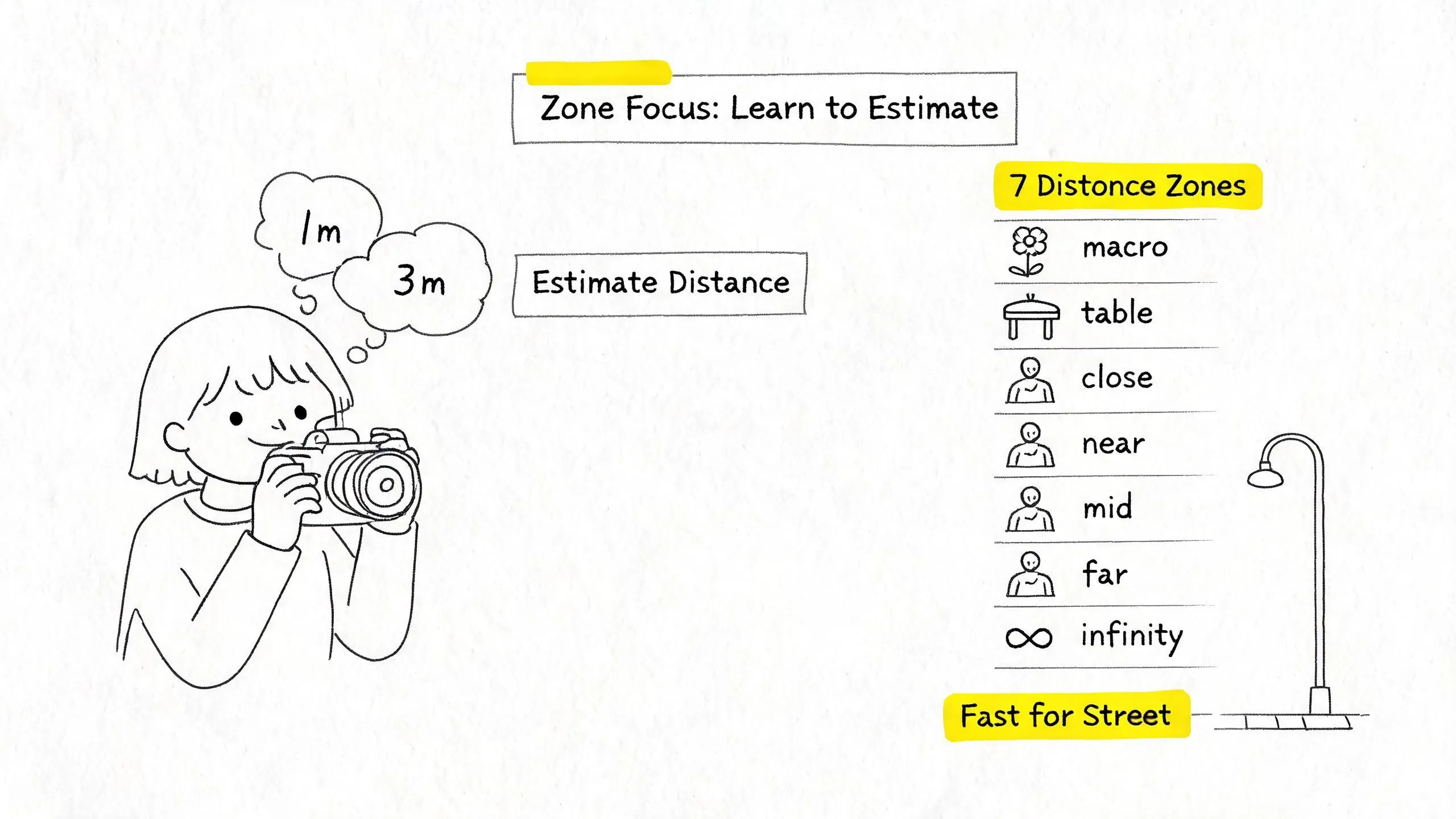
The Pentax 17 uses a seven-zone focusing system, another core aspect of its handling and the main part users need to learn. Focus distances are divided into: Macro 0.25m, Tabletop 0.5m, Ultra-close 1.0-1.4m, Close 1.4-2.2m, Mid-range 2.1-5.3m, and Infinity 3m to ∞ (Source: Ricoh China official feature introduction; Analogue Wonderland review).
Real-World Experience:
- Pros: Once familiar, zone focusing is highly efficient, especially for street photography and other scenarios requiring quick reactions. The viewfinder’s icon prompts and the body’s warning light system effectively reduce misoperation. A clever design is that the included wrist strap measures exactly 25cm when straightened, useful for precisely measuring subject distance in macro shooting .
- Challenges: Estimating focus is the steepest learning curve. Beginners often “struggle to gauge the distance to the subject” . Community users share the tip: first set the focus ring to infinity, then dial back the appropriate number of zones based on the subject’s distance .
- Zone Recommendations:
- Macro/Tabletop: Ideal for food and small objects, requiring strict distance control.
- Close/Mid-range: Covers the most common 1.5-5 meter range for daily portraits and street photography, making it the most frequently used zone.
- Infinity: For landscapes, architecture, etc., usually ensuring sharpness as long as the subject isn’t close.
With practice, the success rate of zone focusing can be high. It’s not a replacement for autofocus but a more “photographic” focusing method that requires active engagement.
Should You Buy It? A Horizontal Comparison with Competitors at Similar Prices
The Pentax 17 is priced at ¥3,999 in China and $499.95 in the US . This pricing is a focal point of debate. We compare it with several key competitors:
| Feature | Pentax 17 | Kodak Ektar H35N | Lomo MC-A | Used Olympus mju-II |
|---|---|---|---|---|
| Type | Half-frame film camera | Half-frame film camera | Full-frame film camera | Full-frame point-and-shoot |
| Price Range | ¥3,999 / $500 | ¥500 / $65-70 | ¥3,600 / $500-550 | ¥2,200-3,100 / $300-440 |
| Lens | 25mm f/3.5 prime | 22mm f/11 prime | 32mm f/2.8 prime | 35mm f/2.8 prime |
| Focusing | Seven-zone zone focus | Fixed focus (1m) | LiDAR auto + 5-zone manual | Autofocus |
| Core Advantages | All-new design, excellent lens, viewfinder, warranty | Extremely low price, multiple exposures | Full-frame, metal body, autofocus | Classic model, weather-sealed, portable |
| Main Disadvantages | Half-frame, zone focus learning curve, high price | Average image quality, basic features | Price proximity, average viewfinder | Used risks, no warranty, unknown condition |
Analysis:
- vs Kodak Ektar H35N: The H35N costs only a seventh of the Pentax 17, but there’s a huge gap in lens quality and functionality—it’s essentially “disposable camera territory” . If your budget is extremely limited and you just want to try half-frame, the H35N is an entry point; if you seek reliable image quality and handling, the Pentax 17 is a quantum leap.
- vs Lomo MC-A: This is the most direct competitor, with a similar price. The MC-A is full-frame, with autofocus and a metal body. However, the Pentax 17 has a superior viewfinder, more advanced lens coating technology, and as an all-new design, its modernity and Pentax’s brand endorsement are unique selling points. The choice depends on whether you prioritize full-frame + autofocus or half-frame economics + the reliable experience of a new camera from a major brand.
- vs Used Olympus mju-II: The mju-II is a legendary model with more powerful features (autofocus, weather-sealing). But the used market is risky, conditions are uncertain, and there’s no warranty. The Pentax 17’s advantages are its brand-new condition, warranty, and out-of-the-box peace of mind, along with stable output from modern coating and metering technology.
Conclusion: Who Should Buy the Pentax 17?
The Pentax 17 is not a camera trying to please everyone. It is a tool with distinct characteristics and equally prominent pros and cons.
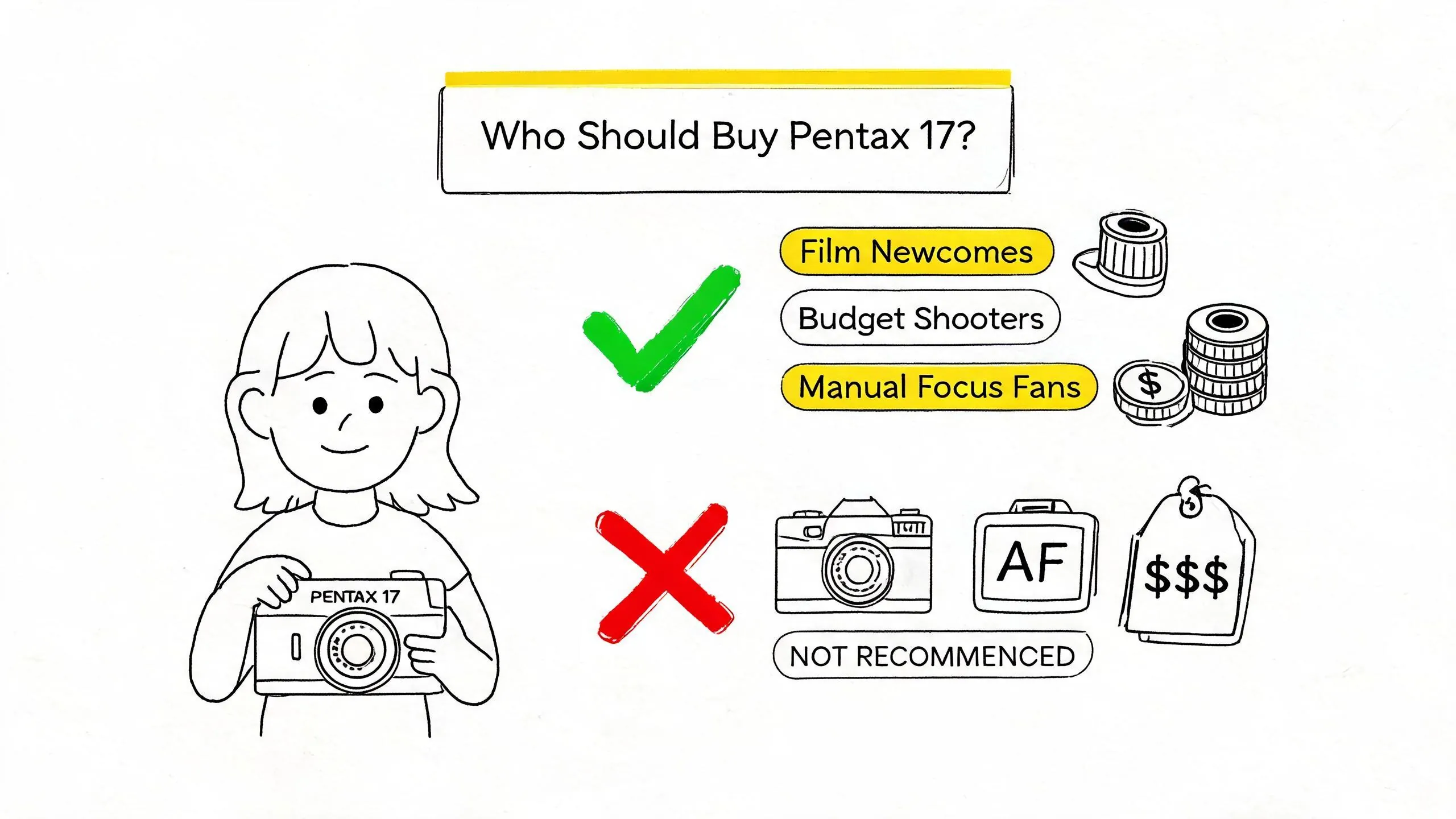
It’s for you if:
- You’re a film photography beginner looking to start with a reliable, modern, new camera with a warranty, rather than taking risks in the used market.
- You value shooting economy, wanting more shots per roll to reduce the cost of experimentation.
- You enjoy vertical compositions or want to challenge your compositional habits with the half-frame format.
- You appreciate the ritual of mechanical operation (manual advance) and are willing to learn zone focusing.
- You recognize Pentax’s brand value and see this as supporting the future of film photography.
It might not be for you if:
- You seek ultimate value for money, believing the same money should buy a full-frame or more feature-rich used camera.
- You cannot accept the image quality cropping and vertical orientation limitations of the half-frame format.
- You need the convenience of autofocus or frequently shoot in very dark environments (flash recycle time is about 9 seconds).
- You are very sensitive to shutter lag and need to capture extremely fast moments.
Final Verdict: The Pentax 17 is a sincere effort. With solid build quality, an excellent lens, and modern technology, it proves that film cameras can still have new, excellent forms in 2024. It may not be the most cost-effective choice, but it offers a unique experience: a brand-new half-frame film camera from a major manufacturer, with novel design, reliable imaging, and great shooting enjoyment. For those moved by its philosophy and willing to accept its characteristics, it’s not only worth buying but may also become a long-term, reliable companion on your film photography journey.
(Note: Pentax Film Project chief designer TKO left in early 2025, and Pentax announced a pause in its film camera product line, soliciting user feedback to determine next steps . Therefore, the Pentax 17 is likely to remain Pentax’s only in-production new film camera for some time, which may add to its collectible and practical value.)
References
- Back to the future: Pentax 17 film camera review - DPReview
- Pentax 17 Camera Review: A Modern Wonder - Analogue Wonderland
- Pentax 17 Review: Lightweight, Reliable, and Plenty of Fun - Shoot It With Film
- Features | PENTAX 17 - RICOH IMAGING (中国官网)
- PENTAX 17 - Pentax EU Official Product Page
- PENTAX 17 Product Page - Ricoh Japan
- PENTAX 17 - Ricoh US Official Store ($499.95)
- PENTAX Film Camera Project shifts to the next stage - RICOH IMAGING News
- PENTAX 17 Specifications & Details - Pentax EU Blog
- Pentax 17 Comprehensive Review - 35mmc