5 Budget Autofocus Point-and-Shoots for Film Beginners (300-500 RMB) – The Golden Balance of Image Quality, Portability, and Price
For those just stepping into the world of film, sub-100 RMB "toy" cameras may have a low barrier to entry, but they often suffer from significant shortcomings i
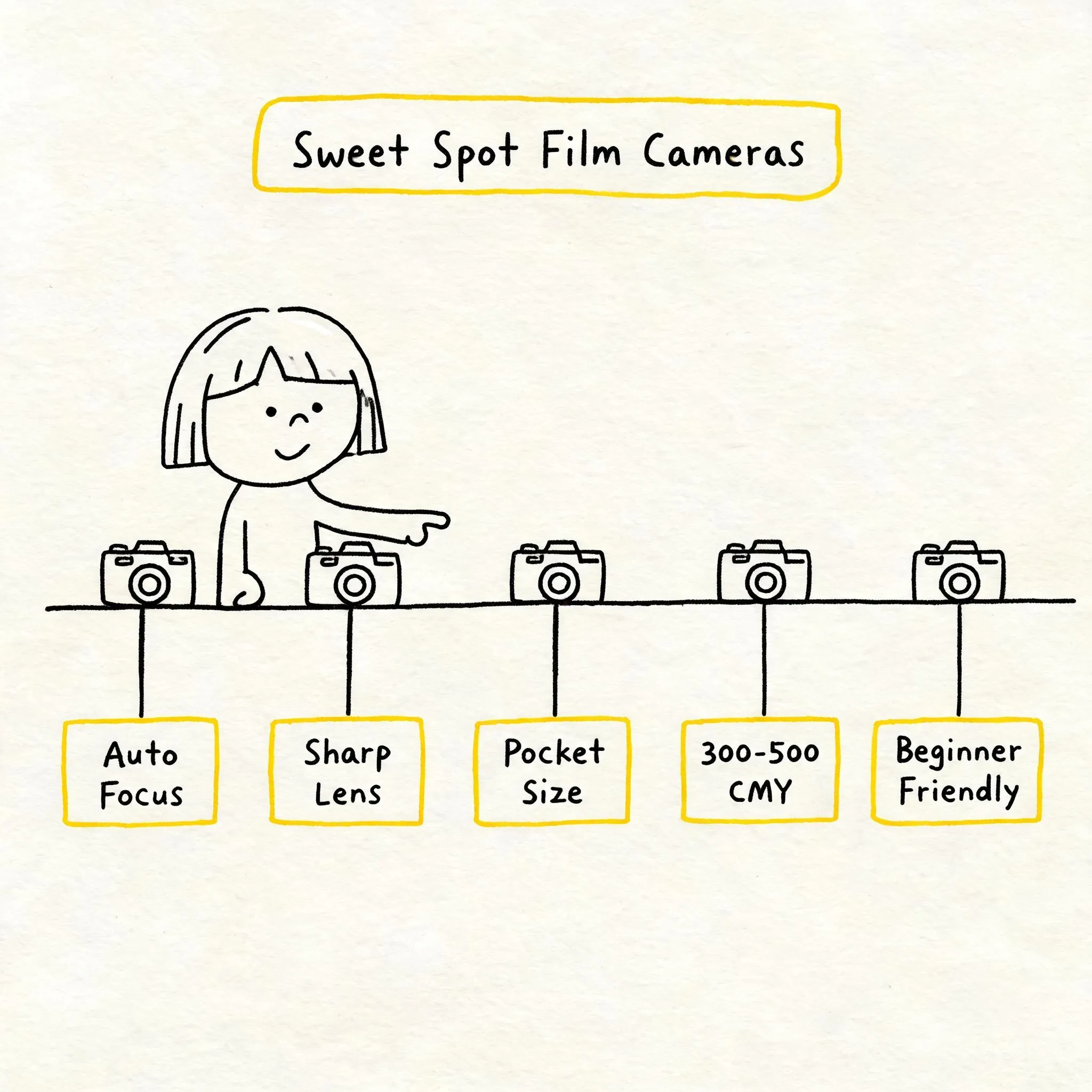
Why 300-500 RMB is the “Sweet Spot” for Beginners – The Value Proposition of Autofocus Point-and-Shoots
For those just stepping into the world of film, sub-100 RMB “toy” cameras may have a low barrier to entry, but they often suffer from significant shortcomings in image quality and focusing accuracy, making it easy to miss decisive moments. When you want to move from just “getting the shot” to “getting a good shot,” a reliable autofocus system and a decent lens become crucial. The 300-500 RMB price range in the used market is precisely this “sweet spot.”
Autofocus point-and-shoots in this bracket, born during the mature era of film camera technology (the 1990s), generally offer the following advantages: reliable autofocus systems (mostly infrared or active AF, far more accurate than zone-focus models), decent lens quality (many feature multi-coated glass elements), and compact size (truly pocketable). They are the ideal stepping stone from “documentation” to “creation,” allowing you to experience the core functionality of high-end point-and-shoots on a limited budget. As some professional reviews have noted, cameras in this range can “punch above their weight” in image quality and features compared to more expensive models .
Next, we will delve into 5 underrated “value kings” in this price range from Olympus, Pentax, Konica, Ricoh, and Canon. Each has its unique strengths, and one is sure to suit you.
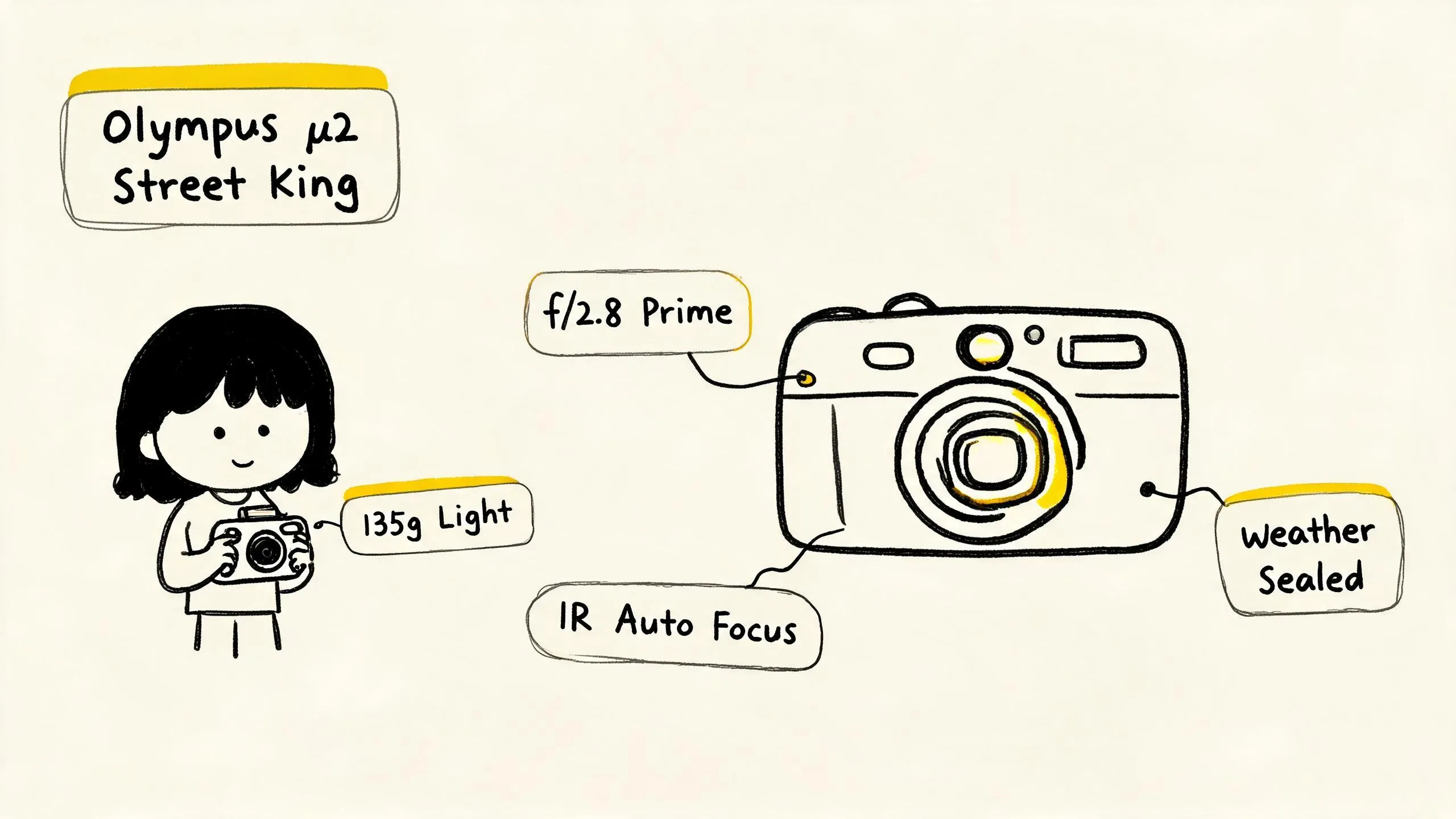
Olympus μ2 (Olympus Stylus Epic) – The Compact Street Photography Powerhouse with a Fast Lens
The Olympus μ2 (known as the Stylus Epic in overseas markets) is an undisputed “internet celebrity” among film point-and-shoots, but its popularity is well-deserved. Released in 1997, this camera proved what “small body, big power” truly means .
Core Advantages & Specifications:
- Lens: Equipped with a 35mm f/2.8 equivalent prime lens in a 4-element, 4-group design. This lens is exceptionally rare at this price point for offering a fast aperture, allowing for faster shutter speeds in low light and the ability to create some background blur .
- Autofocus & Metering: Uses an active infrared multi-beam autofocus system with 3 AF points and supports AF lock. The minimum focus distance is 0.35m. Its infrared AF allows it to focus relatively accurately even through glass . It also offers spot metering, a feature very rare in entry-level point-and-shoots, enabling precise exposure for specific parts of the frame.
- Body & Durability: The body measures only 108×59×37mm and weighs 135g, making it lightweight and portable. More importantly, it features a weatherproof shell, handling light rain or accidental splashes without issue .
- Image Style: The image quality, color, and rendering from its 35mm prime lens are “nothing like a point-and-shoot camera,” earning it the title of “the smartest autofocus compact” from Lomography . Many photographers praise its rich colors and high contrast, making it excellent for travel and daily documentation .
Drawbacks & Considerations:
- ISO cannot be manually adjusted (requires “DX hacking”), and camera settings cannot be saved.
- Exposure tends to favor wide apertures, which may sometimes not suit landscape photography requiring deep depth of field .
- Due to its hype, its price was once inflated to nearly 1000 RMB. While it has since fallen, it remains the model with the highest premium in this recommendation .
Ideal For: Users who prioritize ultimate portability, enjoy street photography and documentary work, have some requirements for low-light shooting, and don’t mind paying a premium for brand and design.
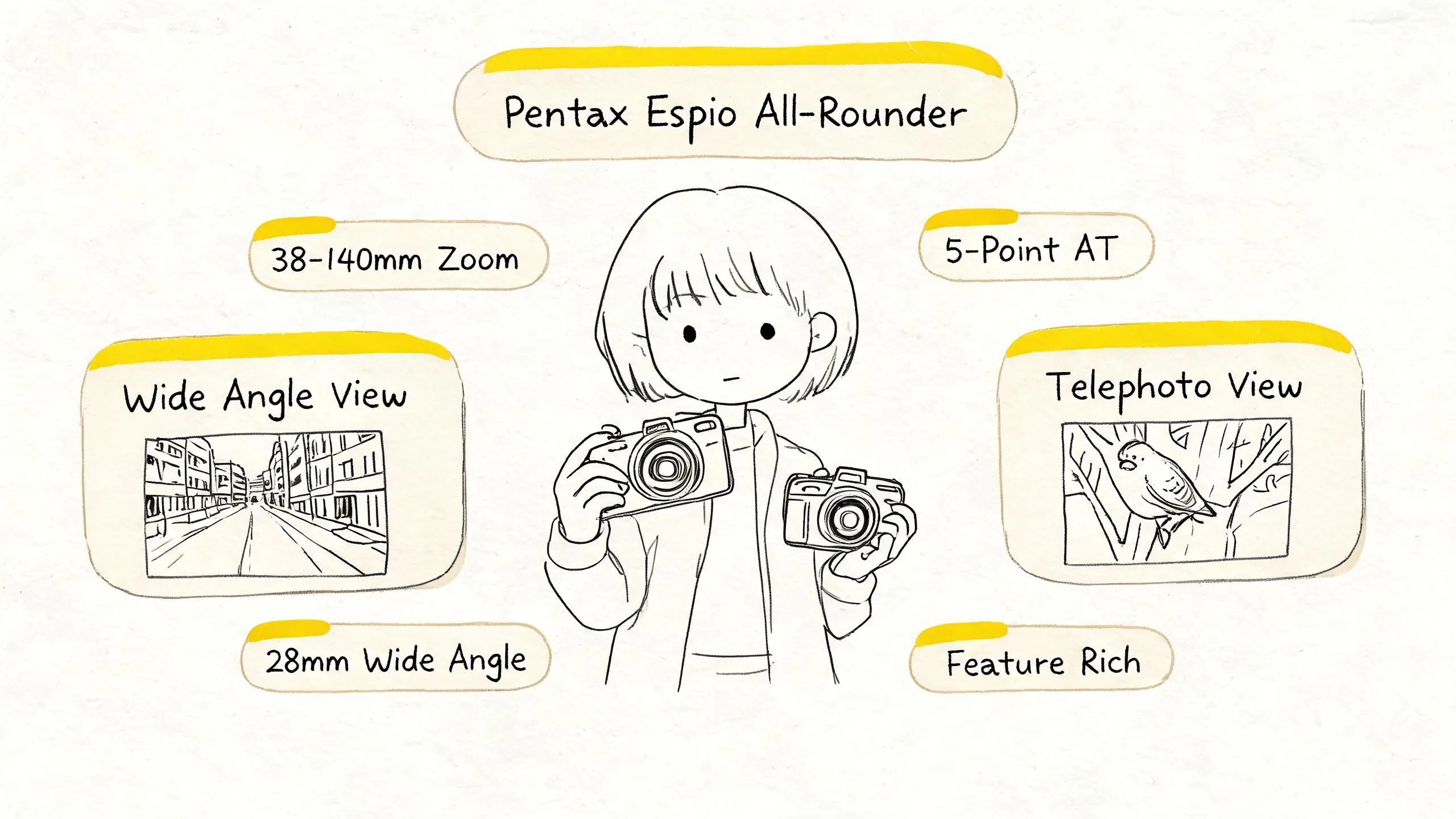
Pentax Espio 140/928 – The All-Rounders Among Zoom Point-and-Shoots
If you find the 35mm prime perspective too limiting, the Pentax Espio series, particularly the Espio 140 and Espio 928, are excellent choices. They represent the pinnacle of practicality in zoom point-and-shoots.
Espio 140: The All-Rounder Zoom
- Lens & Zoom: Features a 38-140mm power zoom lens with an aperture of f/4.1-10.2, covering common focal lengths from wide-angle to medium telephoto, making it a true “one camera for all” solution .
- Features & Operation: Supports 5-point AF, multiple exposures, and a panoramic crop mode, offering very comprehensive functionality. Its lens is praised as “sharp with good flare resistance,” and the body feels solid . A review on 35mmc.com even called it “the second-best zoom point-and-shoot I’ve ever used” .
- Price & Drawbacks: In the international used market, it’s around $100-200, with ample supply domestically, offering excellent value . Drawbacks include a thicker body that only fits in a coat pocket, small LCD icons, and an illogical default ISO of 25 when using non-DX coded film .
Espio 928: The Wide-Angle Choice
- Released in 1994, this model features a 28-90mm zoom. Its 28mm wide-angle end is its biggest highlight, making it ideal for landscape and architectural photography . It also includes an “easy shoot” mode that locks the 28mm focal length for simplified operation.
Ideal For: Users who need versatile zoom ranges, seek comprehensive functionality, and are not overly concerned about body portability (can accept a slightly larger size). The Pentax Espio series is a true “jack-of-all-trades” with no obvious weaknesses.
Konica Big Mini Series – The Stylish Icon for 35mm Documentary Photography
The Konica Big Mini series, especially the flagship Big Mini F, stands out among point-and-shoots with its unique imaging style and fashionable design.
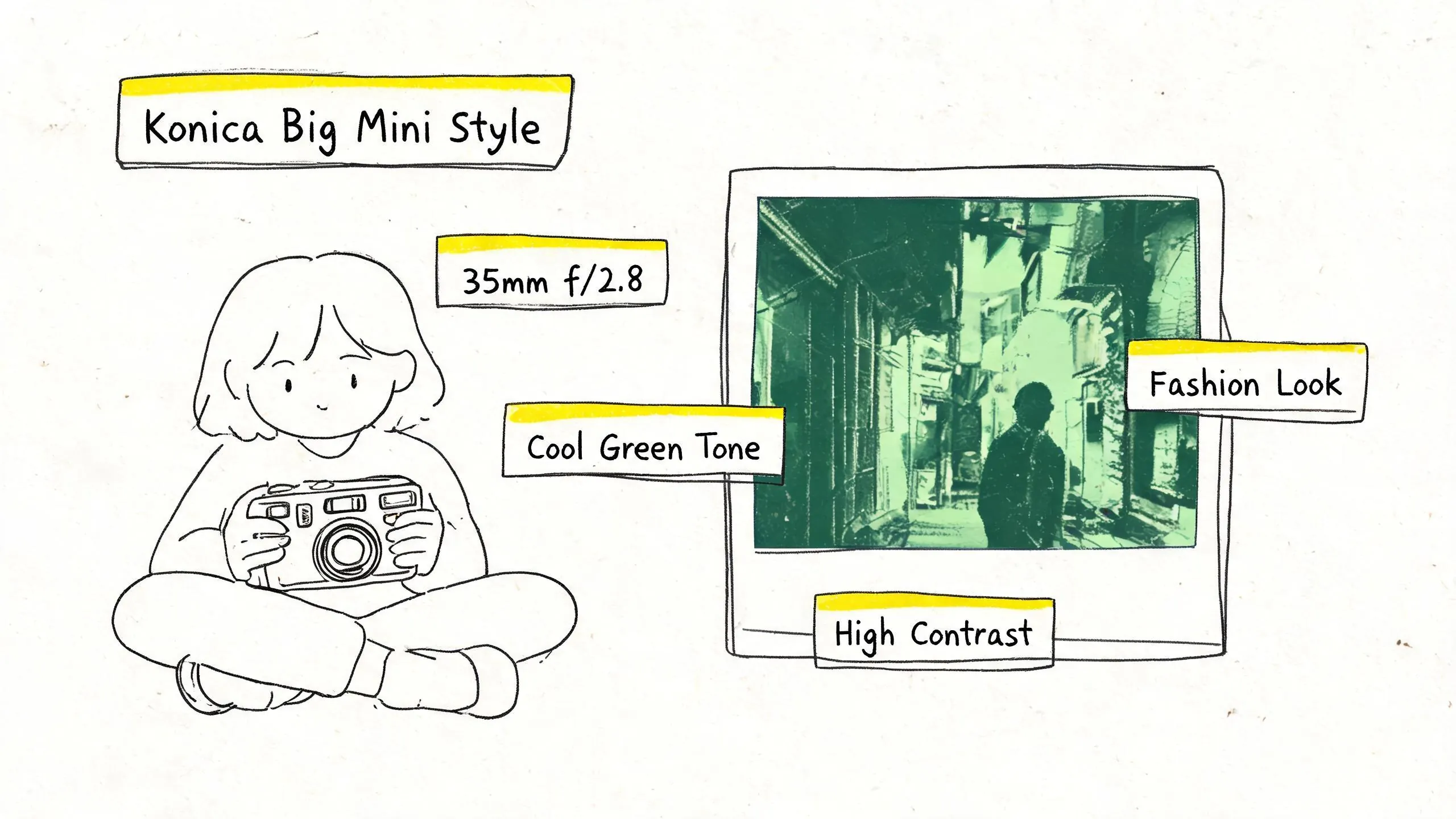
Big Mini F: Stylized Imaging
- Lens & Imaging: Equipped with a 35mm f/2.8 lens using 3-element, 4-group Konica coated glass. Its imaging has a distinct “Big Mini lens character”: high contrast, cool-toned greens, excellent color saturation, and superb flare control . This modern style is beloved by many photography enthusiasts.
- Performance Specs: Minimum focus distance of 35cm, top shutter speed of 1/450s, ±1.5EV exposure compensation. Body dimensions are 12×6×3.5cm, weighing 180g . AF speed is “very fast” .
Other Models in the Series:
- BM-201: The first-generation model with a 35mm f/3.5 lens. It’s cheaper but has louder motor noise .
- BM-302: Has lower motor noise than the BM-201 and is also cheaper. Its close-focus performance is even slightly better than the F model .
Drawbacks & Considerations:
- The reliability of the entire series is questionable, often described as “fun but fragile” .
- Exposure tends slightly towards underexposure, and the default ISO is 25 when using non-DX coded film .
Ideal For: Users who pursue unique color rendering and stylized expression, enjoy the 35mm documentary perspective, value camera aesthetics, and can accept the potential reliability risks.
Ricoh FF Series – The “Ugly but Cheap” Hidden Gems
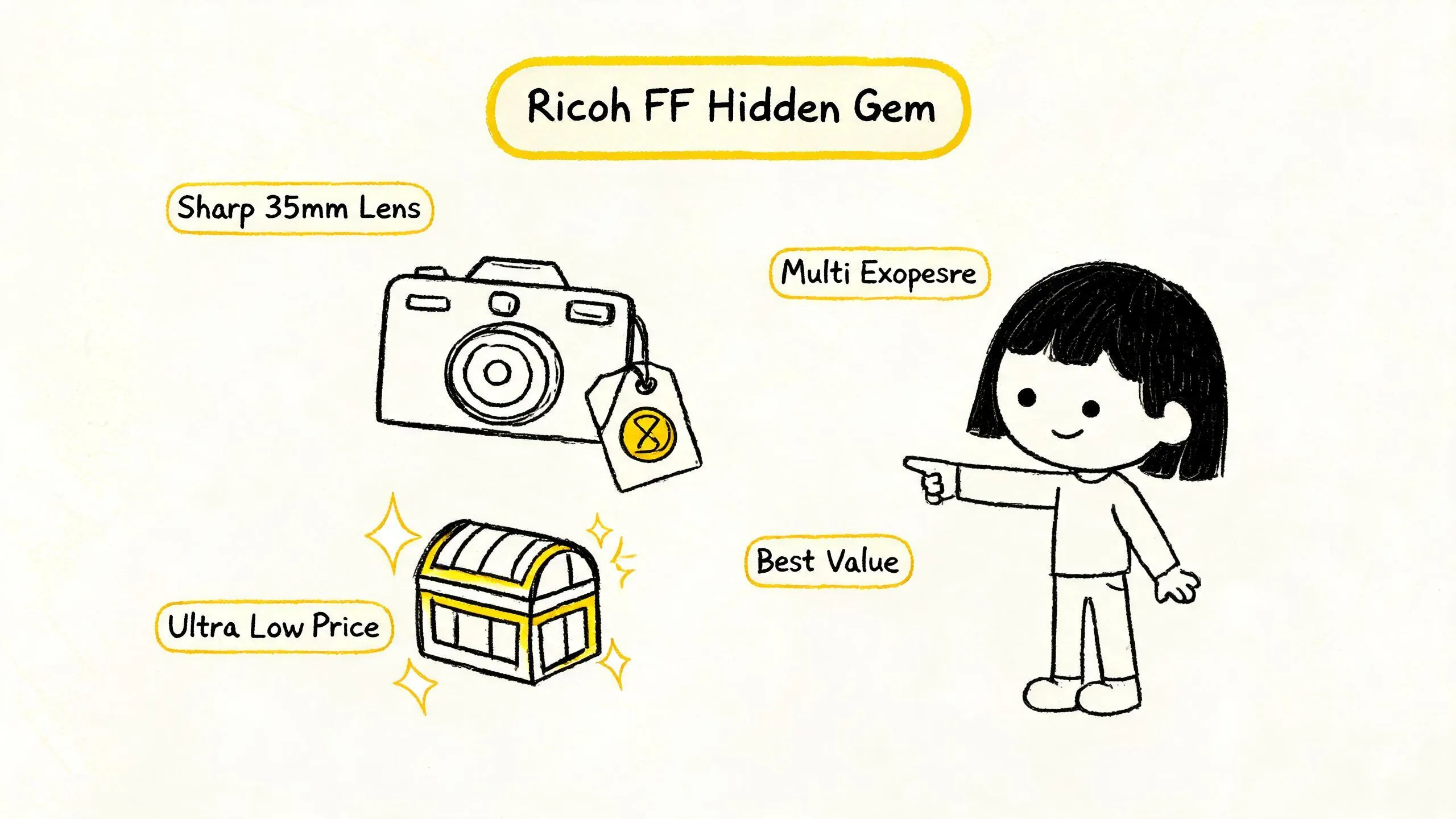
The Ricoh FF series (e.g., FF-9, FF-7, FF-10) offers the highest value for money in this recommendation, truly earning the title of “hidden gem.” Their appearance is plain, even somewhat bulky, but they hide solid performance within.
Core Advantage: Ultimate Value for Money
- Lens Quality: Take the FF-9 as an example. Its 35mm f/3.5 lens produces sharp images with high contrast, excellent coating, and very good control over flare and vignetting . A Kosmo Foto review even suggests it would still be recommended even if its price doubled or tripled .
- Rich Features: At its low price, it offers multiple exposures, interval shooting (60 mode), TV mode (1/30s shutter), continuous shooting, and other rich functions, which are very rare for models in this price range .
- Price: On UK eBay, the FF-9 can be found for as low as £9.5, about 10% of the price of an Olympus μ2 . Domestic Taobao prices are also extremely low.
Drawbacks:
- The design is “serious” and bulky, not very fashionable .
- The 6-step AF precision is limited, and there is no manual ISO setting.
- Motor noise is relatively loud, and the flash cannot be fully closed after popping up (requires manual holding) .
Ideal For: “Practical” beginners with extremely limited budgets who prioritize functionality and feature richness over camera appearance and seek the ultimate value for money. It’s a litmus test for whether you truly love film photography itself, rather than just the gear’s aesthetics.
Canon Autoboy Series – The Feature-Packed “Jack-of-All-Trades”
The Canon Autoboy (known as Sure Shot overseas) series is Canon’s flagship line in the point-and-shoot market, with a rich product range to satisfy various needs.
Series Highlights:
- Solid Imaging: Canon lenses generally produce solid images, with a particularly good reputation for rendering skin tones in portraits and relatively smooth bokeh .
- Diverse Models:
- Autoboy 2 (AF35M II): Features a 38mm f/2.8 prime lens. Basic but extremely reliable, using common AA batteries, making it a great entry-level choice .
- Autoboy S/SII: Offers 38-115mm or 38-135mm zoom lenses, supports multiple shooting modes (sports, portrait, night, etc.), and has more comprehensive features .
- Autoboy F: Features a 32mm f/3.5 prime lens. Compact and stylish, it’s very popular in the domestic used market .
- Autoboy Tele: Unique dual-prime design (40mm f/2.8 + 70mm f/4.9). Theoretically more reliable without a zoom motor .
- Price Range: In the domestic used market, basic models like the Autoboy 2 can be found for 200-300 RMB, while zoom models are slightly more expensive but generally stay within the 300-500 RMB range, described as “cabbage prices for 80s film vibes” .
Drawbacks:
- Some models have loud shutter sounds and slightly heavy bodies.
- No manual ISO setting; requires DX hacking .
Ideal For: Users who seek reliability, durability, comprehensive features, and high brand trust, wanting a camera that is a true “jack-of-all-trades.” The Canon Autoboy series is a safe choice that’s hard to go wrong with.
Buying Guide: How to Find a Good Condition Unit in the Used Market
Patience and a keen eye are equally important when hunting for cameras in the used market. Be sure to follow these steps to avoid pitfalls:
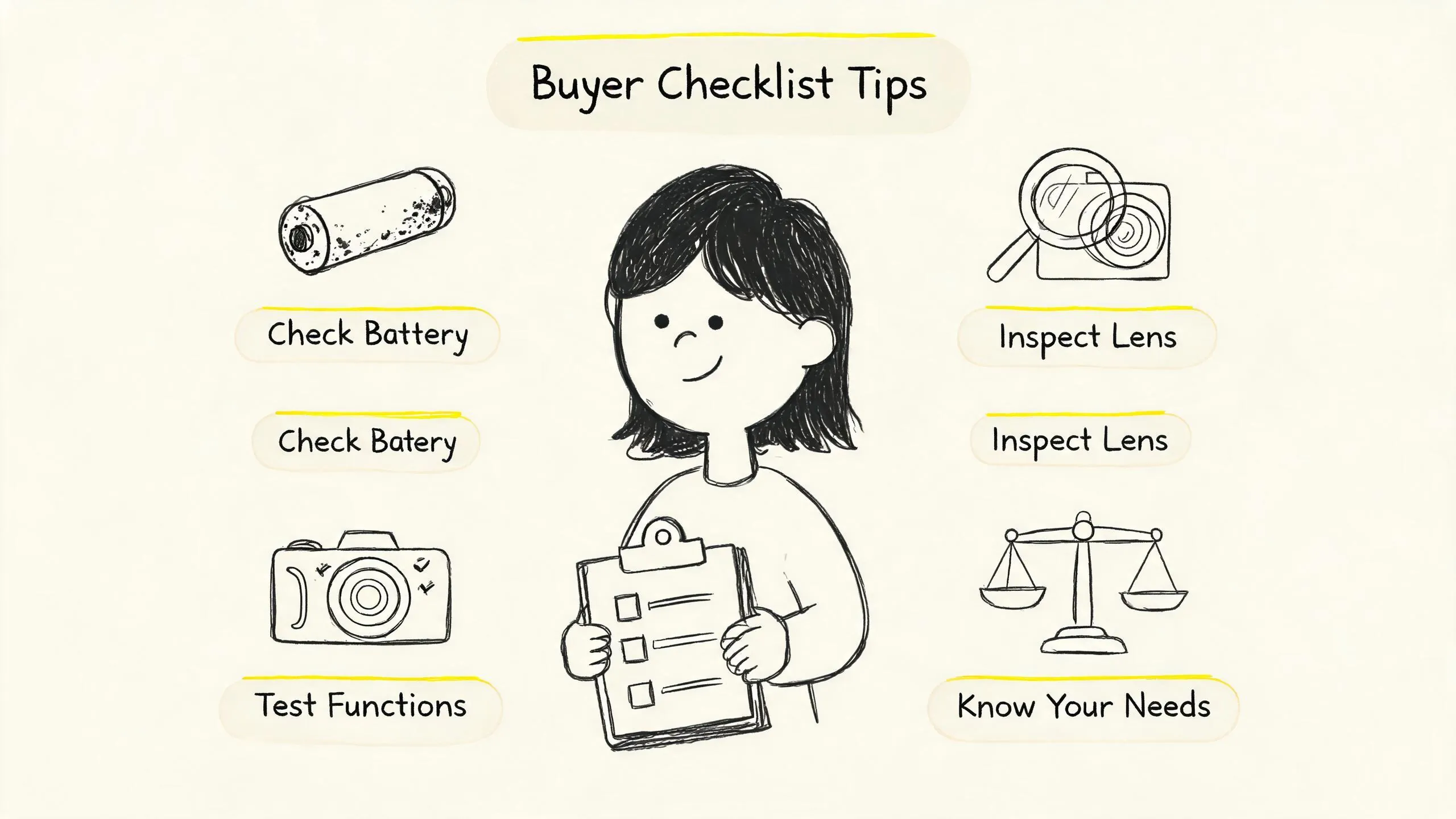
- First, Check the Battery Compartment: This is the biggest killer of used cameras. Open the battery compartment and carefully inspect the internal contacts for any green or white corrosion. A corroded unit likely has a damaged circuit board, which is difficult to repair .
- Inspect the Lens and Viewfinder: Hold them up to a light source and carefully look inside the lens and viewfinder elements for fungus, haze, or significant scratches. Fungus severely affects image quality and can spread. Mild haze may reduce contrast but can sometimes create a unique atmosphere.
- Test Electronic Functions:
- Insert new batteries (check the model), turn it on, and listen for smooth lens extension/retraction.
- Half-press the shutter to confirm the AF confirmation beep and indicator light work.
- Test the shutter: Listen for a crisp shutter sound and smooth film advance in different lighting conditions.
- Test the flash: Manually pop it up and confirm it charges and fires normally.
- Test the zoom (if applicable): Check for smooth zoom motor operation and any unusual noises.
- Note the Film ISO Setting: Many point-and-shoots default to ISO 25 or 100 when using non-DX coded film, which can lead to incorrect exposure. Before buying, it’s best to know the model’s default value and learn simple “DX hacking” techniques (using black tape to cover specific DX code contacts) to manually set the ISO .
- Balance Appearance vs. Functionality: Weigh your budget and needs. For example, the Ricoh FF series has poor aesthetics but strong features and low price; the Olympus μ2 has a refined design but commands a premium. Clarify whether your core need is image quality, functionality, or aesthetics.
Conclusion: Autofocus point-and-shoots in the 300-500 RMB range are the golden stepping stones for film beginners to elevate their shooting experience. From the fast-aperture prime Olympus μ2, to the all-round zoom Pentax Espio, the uniquely styled Konica Big Mini, the value-for-money Ricoh FF, and the reliable all-rounder Canon Autoboy, each represents a different value proposition. Based on your shooting subjects, budget, and aesthetic preferences, choose carefully and perform thorough used-market checks. With a limited budget, you can embark on a film photography journey rich in texture. Remember, the best camera is always the one you’re willing to take out and use often.
References
- 简单,不简单——奥林巴斯μ2使用体验
- Olympus Mju II - 最聰明的傻瓜相機
- 奥林巴斯胶片相机(eBay中国站)
- Olympus Stylus Epic (Mju II) Review — Joseph Saunders
- Olympus Stylus Epic (Mju II) Point and Shoot Film Camera Review
- Olympus Mju II Review - a Skeptical Look at a Cult Favorite
- Pentax Espio 140 - The Second Best Zoom Compact Camera I’ve Ever Had
- Pentax Espio 140V Camera Review — Analog.Cafe
- Pentax Espio 120SW & 928 Review (YouTube)
- Why A Pentax Espio Should Be Top Of Your Compact Film Camera Wishlist