10 Creative Must-Try Techniques Before Peel-Apart Film Disappears: An Advanced Guide from Development Manipulation to Paper Revival
The official discontinuation of Fujifilm FP-100C in 2016 marked the end of the mainstream era of mass-produced peel-apart pack film . Today, FP-100C stock is in
Introduction: In an Era of Finite Sheets, Creativity is the Only Way Forward
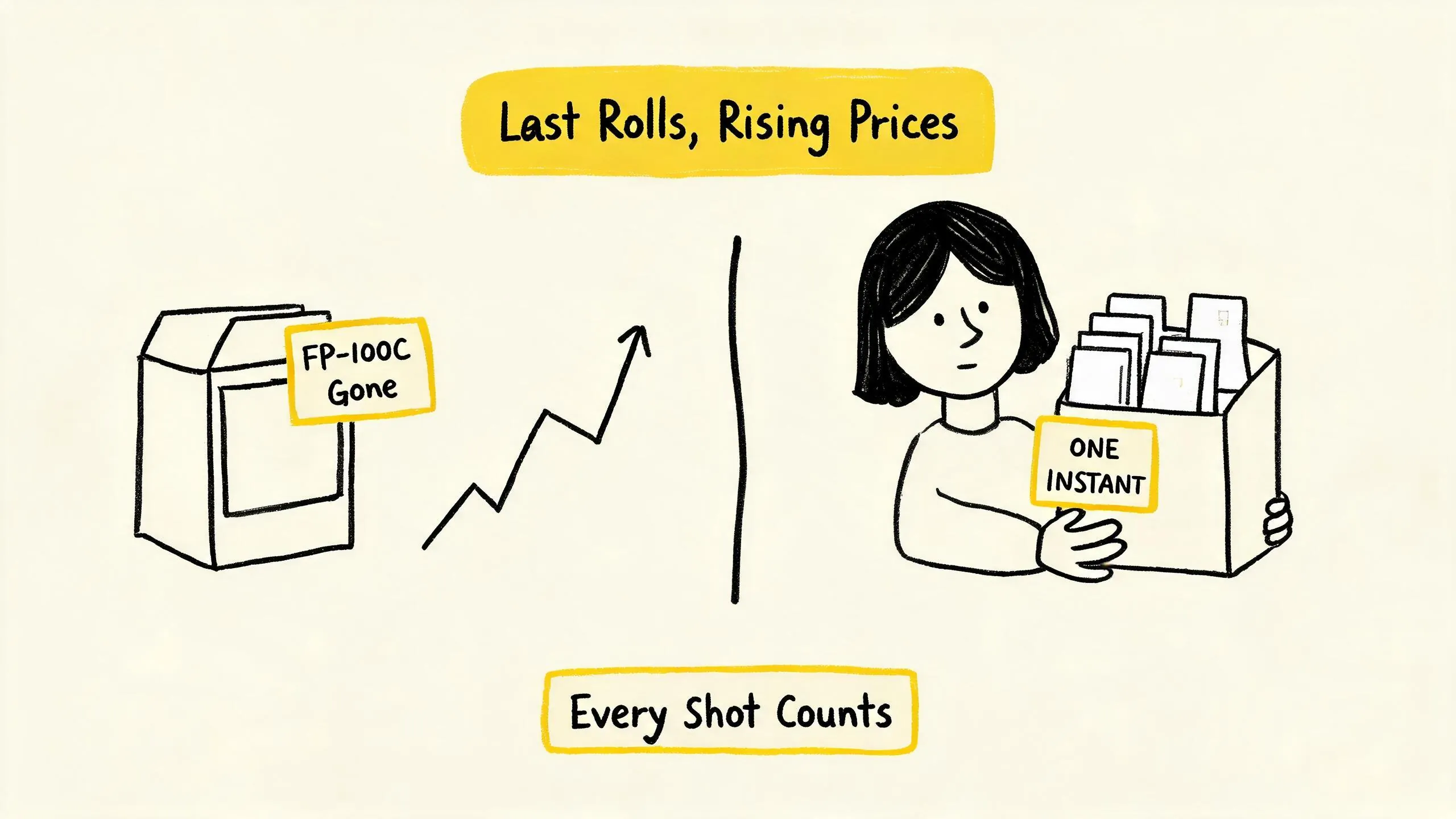
The official discontinuation of Fujifilm FP-100C in 2016 marked the end of the mainstream era of mass-produced peel-apart pack film . Today, FP-100C stock is increasingly scarce, with market prices soaring. A box of 10 expired sheets now commands prices ranging from $100 to $500, described as fluctuating “like the stock market” . Meanwhile, Supersense, the world’s only remaining manufacturer of peel-apart film, offers the ONE INSTANT. While it provides a new option, its format of just 3 sheets per box at €49 means every shutter click is even more precious .
This consensus of “one less sheet with every use” is spreading through global film communities. Taipei’s 997 FILM LAB, when launching its FP-100C experience service, stated bluntly in its copy: “Every time you press the shutter, there is one less peel-apart sheet in the world” . This is not pessimism, but a shift in creative mindset: when material resources become finite and non-renewable, we can focus more purely on the act of creation itself, extracting the full potential from every single sheet.
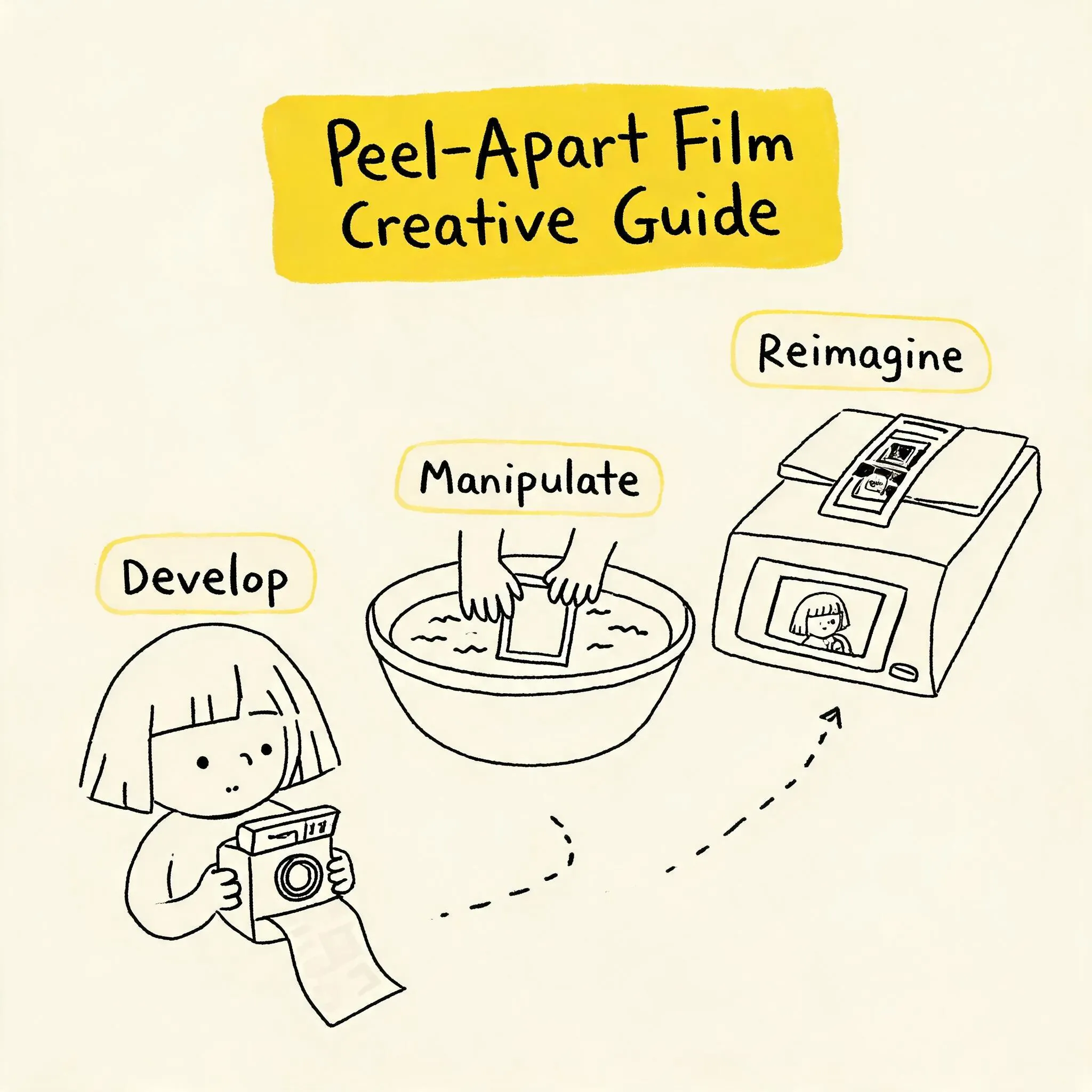
This article is not an introductory tutorial. It is an advanced creative checklist for enthusiasts with existing experience using peel-apart film. We will focus on 10 specific, actionable techniques, divided into two main categories: physical and chemical interventions during the development stage, and secondary creation on the film sheet itself. The goal is to ensure every remaining sheet of peel-apart film in your hands is used to its fullest, maximizing its expressive potential.
I. Market Reality and Creative Motivation: The Final Feast
Before diving into the techniques, it’s essential to understand the environment we’re in. This is not just background context; it’s the driving force behind our creative experiments.
1.1 Depleted Stock and Soaring Prices
Following the discontinuation of Fujifilm FP-100C, its stock has entered the final phase of depletion. The average market price in 2026 has stabilized at $100–$300 per box, with some well-preserved, latest batches (produced in 2016, expired in 2018) even being priced at $500 per box . eBay is currently a relatively reliable purchasing channel, but prices are volatile, and careful scrutiny of sellers’ descriptions of storage conditions is required.
1.2 The Only Current Option: Supersense ONE INSTANT
Founded by Florian Kaps, creator of The Impossible Project, Supersense is currently the world’s only company still producing peel-apart film . Its ONE INSTANT Classic line offers three choices: Color (P7), Black & White, and CHOCO (a chocolate-toned monochrome), with a development time of 2 minutes 30 seconds (at 20°C) . Notably, the negative base of ONE INSTANT is a black polyester substrate, which cannot be bleached, a fundamental difference from Fujifilm FP-100C . Additionally, Supersense launched a DIY Film Kit in 2023, shifting part of the assembly process to the photographer to reduce costs and inspire new techniques .
1.3 Creative Consensus: Maximize Every Sheet
Whether facing expensive stockpiled FP-100C or the high per-sheet cost of ONE INSTANT, the community consensus is: every sheet must deliver maximum value. This has spawned two creative directions: intervening during the shooting and development stage to alter the final image, and performing secondary creation on the film sheet itself to explore its potential as a physical material.
II. Development Stage Interventions: 5 Techniques to Manipulate the Final Image
In the brief window between pulling the film from the camera and the image stabilizing, there is a short “creative window.” Intervening in this process through physical or chemical means can directly alter the image’s color, contrast, clarity, and even structure.
2.1 Controlling Pull Speed and Timing: Dictating the Image’s “Breath”
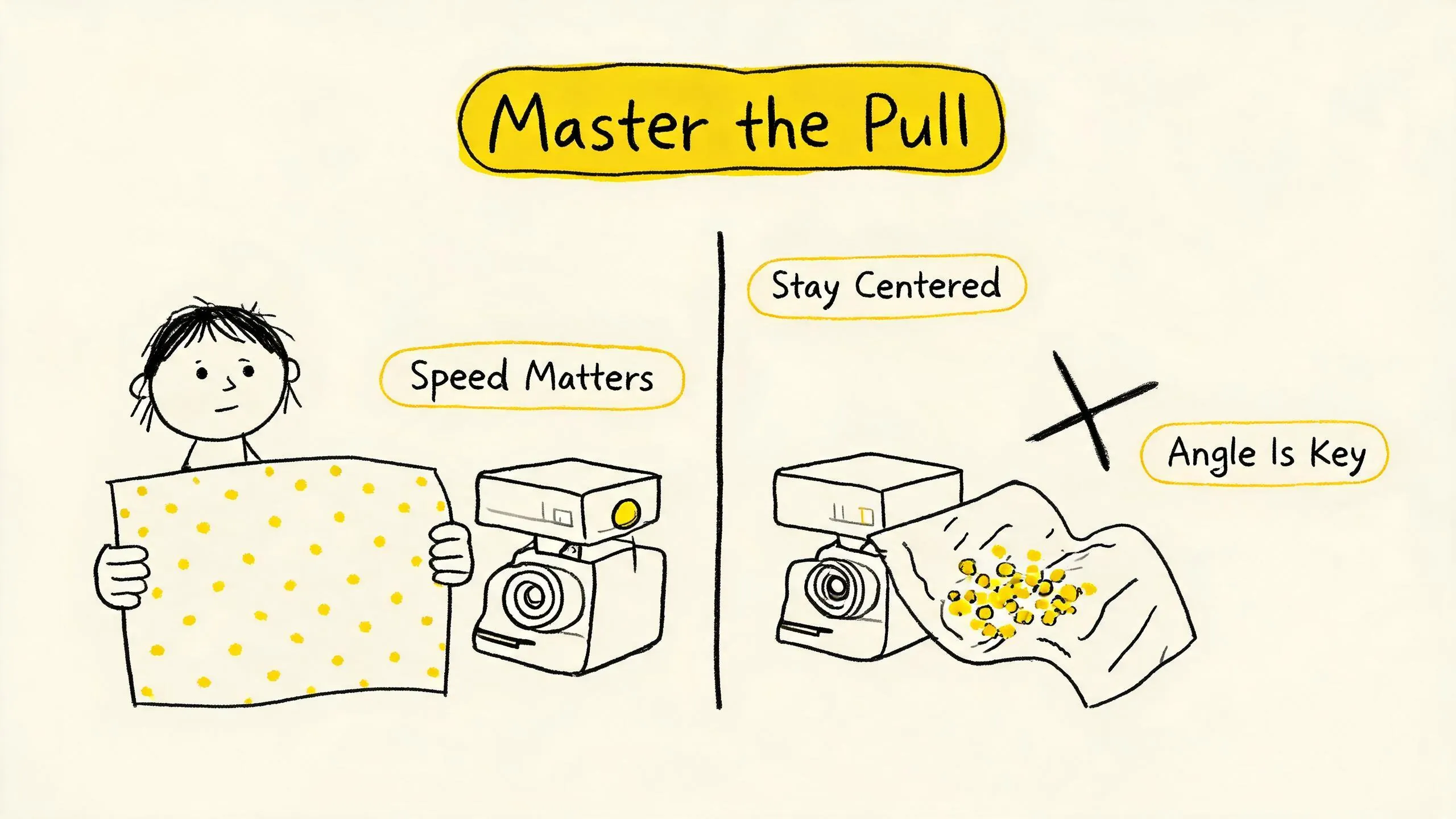
Pulling the film is not simply “pulling all the way through.” The speed and angle of the pull directly affect the distribution and mixing of the reagent between the negative and positive sheets.
- Effect of Speed: According to Supersense’s professional advice, a fast pull creates a narrower development gap (thinner, more evenly covered reagent layer), while a slow pull creates a wider gap. Although the practical difference may be small, finding a “comfortable and controllable” speed is crucial .
- Angle and Direction are Key: The pull angle and direction are far more important than speed. The pull axis must be kept perfectly perpendicular and centered relative to the rollers. An off-axis pull causes wrinkles, misalignment, and uneven coverage. The T-shaped handle design of classic Polaroid Land cameras was specifically intended to help stabilize the pull action . It is recommended to operate with the camera flat on a table for optimal control.
2.2 Refrigeration/Ice Water Quenching: Freezing the Development Process
Development is a chemical reaction, and temperature is a key variable. Low temperatures can slow or even halt this reaction, creating unique tonal effects.
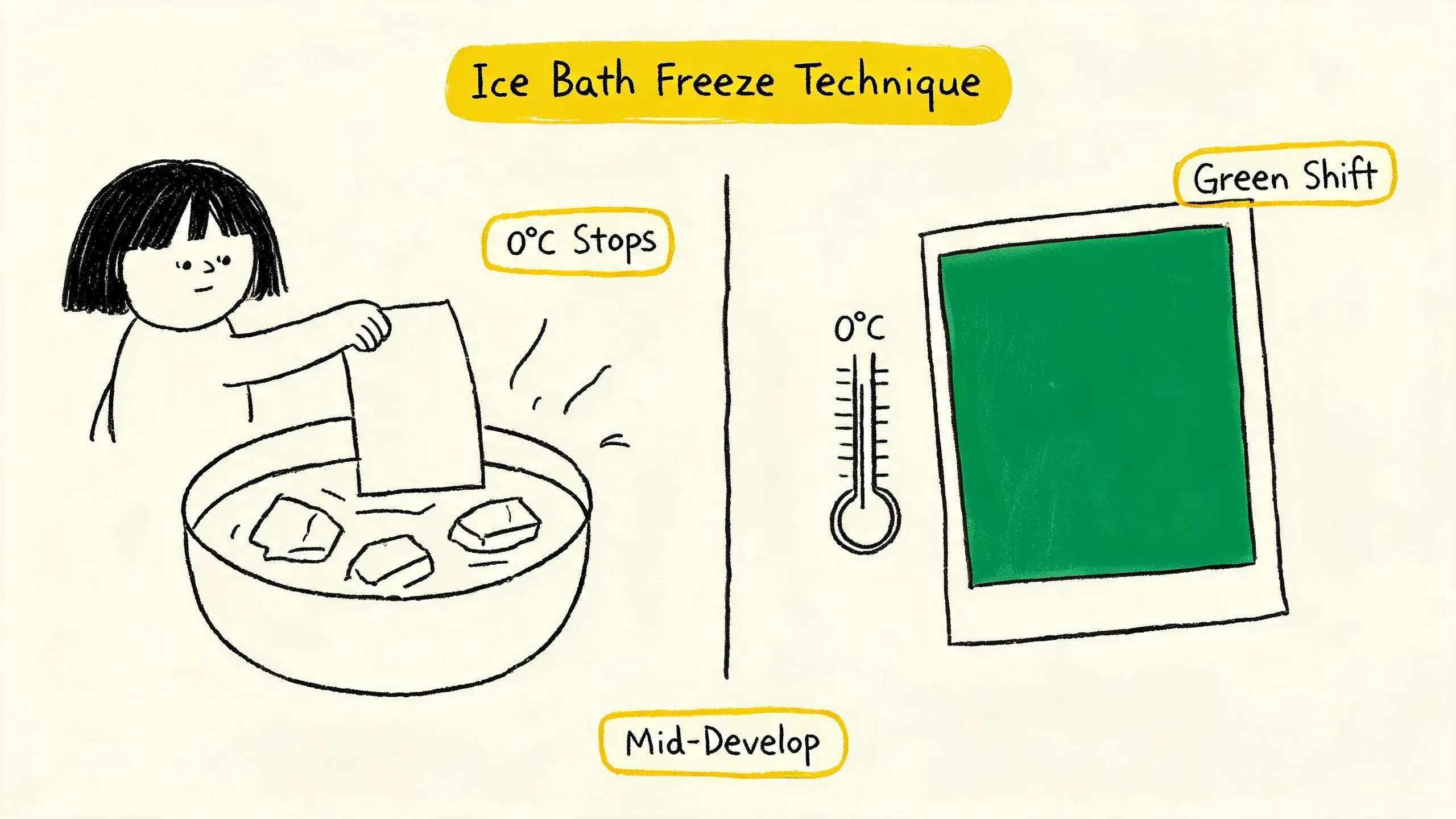
- Low-Temperature Effects: Tests by Figital Revolution show that developing FP-100C at 0°C results in higher contrast and a wider tonal range, but also introduces a noticeable green color cast—a typical effect of prolonged development time at low temperatures .
- Method: Immediately after shooting, submerge the film sheet in ice water. This effectively “freezes” the development process, capturing a mid-development state. This requires repeated experimentation to master the changes brought by different immersion times.
2.3 Local Blocking: Creating Artificial Light and Shadow Zones
During development, the reagent layer on the film is still mixing and reacting. At this stage, partially blocking the film with an opaque object (like cardboard, a finger, or a leaf) can prevent the reagent in that area from mixing fully. This leaves a light or undeveloped mark on the final image, simulating local highlights or special lighting effects.
2.4 Pre-Coating/Color-Changing Chemicals: Subverting the Color Base
This is a more radical technique. After pulling the film but before development is complete, use a cotton swab dipped in specific chemical reagents (such as weak acid, weak base solutions, or diluted food coloring) to carefully apply to specific areas of the film. The reagent will react with the developing chemicals, causing unpredictable color shifts or changes in that area. Warning: This operation carries risks and may produce harmful substances. Perform it in a well-ventilated area while wearing gloves, and fully understand the properties of the reagents.
2.5 Reverse Peeling and Negative Edges: Embracing Imperfection
Standard peeling separates the positive and negative sheets. “Reverse peeling” or intentionally not peeling completely can create unique edge effects. For example, intentionally pausing or changing the angle during the peel allows the reagent to build up at the edges, creating a thick, painterly border. Alternatively, retaining a portion of the negative edge that hasn’t fully separated can incorporate it into the composition, forming a natural vignette or decorative element.
III. 5 Methods for Secondary Creation on the Film Sheet Itself
Once a peel-apart sheet has finished developing, its mission is not over. The film sheet itself—whether the positive image, negative, or emulsion layer—is a unique creative material.
3.1 Converting the Negative to a Positive: Unearthing Hidden Treasure
This is a treasure unique to peel-apart film (especially FP-100C). The peeled negative is not waste; it is a unique negative.
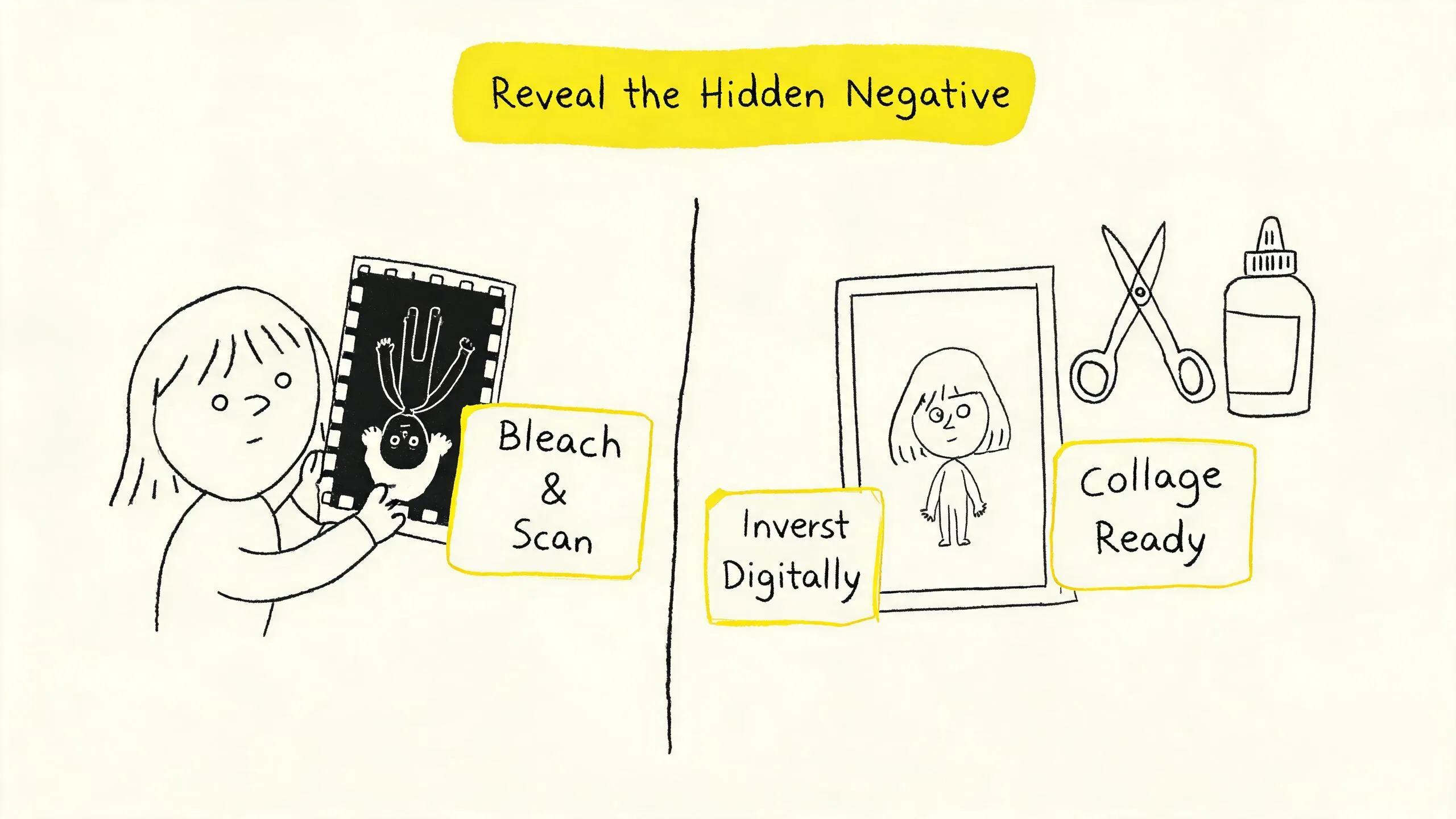
- Bleaching and Scanning: For FP-100C negatives, chemical bleaching (typically using sodium hydroxide, etc.) can remove the opaque backing layer, making it transparent. It can then be scanned or enlarged like a traditional negative to produce a positive image . Important Note: The negative of Supersense ONE INSTANT is coated on a waterproof black polyester base and cannot be bleached .
- Direct Scanning and Inversion: Even without bleaching, you can place the negative directly in a scanner. After scanning, perform an “invert” operation in image processing software to obtain a positive image with unique tones and grain.
3.2 Ink/Crayon Rubbing Transfer
Utilizing the still-untacky reagent layer on the surface of the negative or positive image (or by manually applying ink or crayon), you can use it as a “printing plate” to transfer the image onto paper or other media.
- Method: Gently press a fresh film sheet (positive or negative side) onto absorbent paper, watercolor paper, or fabric. Apply even pressure. The reagent or pigment will partially transfer, creating a hazy, textured mirror image.
3.3 Emulsion Lifting: Creating Specimens and Collages
The imaging layer (emulsion) of peel-apart film is a thin plastic film. After development, if conditions are suitable (e.g., relatively fresh film, moderate humidity), you can attempt to carefully lift this emulsion layer from its base.
- Application: The lifted emulsion is semi-transparent. It can be preserved like a specimen in a book, or used to create collages or lightbox art. It retains the image but has a completely different texture—lightweight and fragile.
3.4 Burning and Scraping: Creating Physical Texture
This is a destructive technique, but it can produce visually striking effects.
- Burning: Carefully burning the edges or specific areas of the film with a lighter or candle flame causes it to curl, melt, and discolor, creating unrepeatable burn marks and textures. Always perform this in a safe environment and have fire suppression measures ready.
- Scraping: Scraping the film surface with sandpaper, a blade, or a needle point can damage the emulsion layer, revealing the base underneath. This creates scratches, spots, or abstract lines, adding a sense of age and narrative to the image.
3.5 Using the Film Back as a Canvas: Mixed Media Experiments
Don’t ignore the back of the film! The back of most peel-apart film is a white or gray plastic base, which is itself a flat canvas.
- Technique: You can draw, write, or even attach other materials (like stamps, dried flowers, fabric) to the back using markers, acrylic paint, or watercolors, transforming a single film sheet into a miniature mixed-media artwork. The front is photography, the back is handcraft, combined into one.
IV. Gear and Consumable Pairings: Safeguarding Your Creativity
Realizing creative ideas requires the right tools and proper storage.
4.1 Camera Choice: Beyond Polaroid
Besides the common Polaroid Land series folding cameras (like the Polaroid 180, whose electronic metering is relatively easy to use ), there are more professional options:
- Polaroid 600SE (“GOOSE”): A professional camera based on the Mamiya Press design, fully manual, equipped with Mamiya Sekor lenses (like the 127mm f/4.7 standard lens), offering outstanding image quality .
- Mamiya Press Series (Super 23/Universal): Features a larger lens ecosystem and accessories. It can use peel-apart film via a film back, making it a choice for those pursuing ultimate image quality and flexibility .
- 4×5 Large Format Cameras: Using a Polaroid 405 or Fuji PA-145 back, Type 100 peel-apart film can be used on large format cameras. However, pay attention to back compatibility; for example, the Fuji PA-45 is not compatible with ONE INSTANT .
4.2 Storage and Transportation: Extending Creative Lifespan
For precious stockpiled film, correct storage is crucial.
- Best Practice: Refrigeration (not freezing) is the optimal choice. Freezing carries risks, but Stephen Schaub’s experiments prove that FP-100C can be safely frozen. The key is: first stabilize in the refrigerator for 48 hours, then place it vertically in the freezer (due to the reagent pod location). Before use, allow it to thaw slowly in the sequence: freezer → refrigerator → room temperature .
- Checking Expiration: Shake the film box. If you cannot hear the “swishing” sound of the liquid in the reagent pod, it may mean the chemicals have dried and become ineffective. Film over 20 years old carries significantly increased risk .
- Transportation: Always keep it vertical and use insulated bags with ice packs to avoid high temperatures and drastic temperature changes.
4.3 Predicting and Salvaging Expired Film
Expired FP-100C often performs surprisingly well, with true-to-life, vibrant colors and typically no significant color cast, making it an excellent material for creative experiments . However, “W”-shaped development marks (whisps) may appear. For expired film, you can try increasing development time or using the aforementioned “ice water quenching” method to test and adjust, finding its optimal state.
V. Creative Case Studies: Inspiration from the Community
Community practice is the most valuable source of inspiration.
- Yuji Watanabe: This photographer based in Paris and Tokyo used exclusively ONE INSTANT P7 color film for fashion editorials in PIBE MAGAZINE, fully leveraging its unique “sense of quirk and adventure” to create dreamy, emotive images .
- Aidan Avery: This Tucson-based photographer conducted an in-depth review of Supersense’s DIY Camera Kit. He used expired FP-100C and Polaroid 665 to shoot in the Arizona desert, showcasing the long-exposure effects of pinhole cameras and the sharp imaging of sliding box cameras, and shared solutions for using standard peel-apart film in DIY cameras .
- Stephen Schaub (Figital Revolution): A pioneer in peel-apart film preservation and freezing experiments, he has advanced the entire community’s understanding of expired film characteristics and preservation methods through extensive empirical data, including low-temperature development and freezing experiments .
The practices of these creators show us that there is no fixed formula for peel-apart film creativity. The key lies in understanding the material’s properties and boldly conducting personalized experiments.
Conclusion: Creating Eternity in the Face of Disappearance
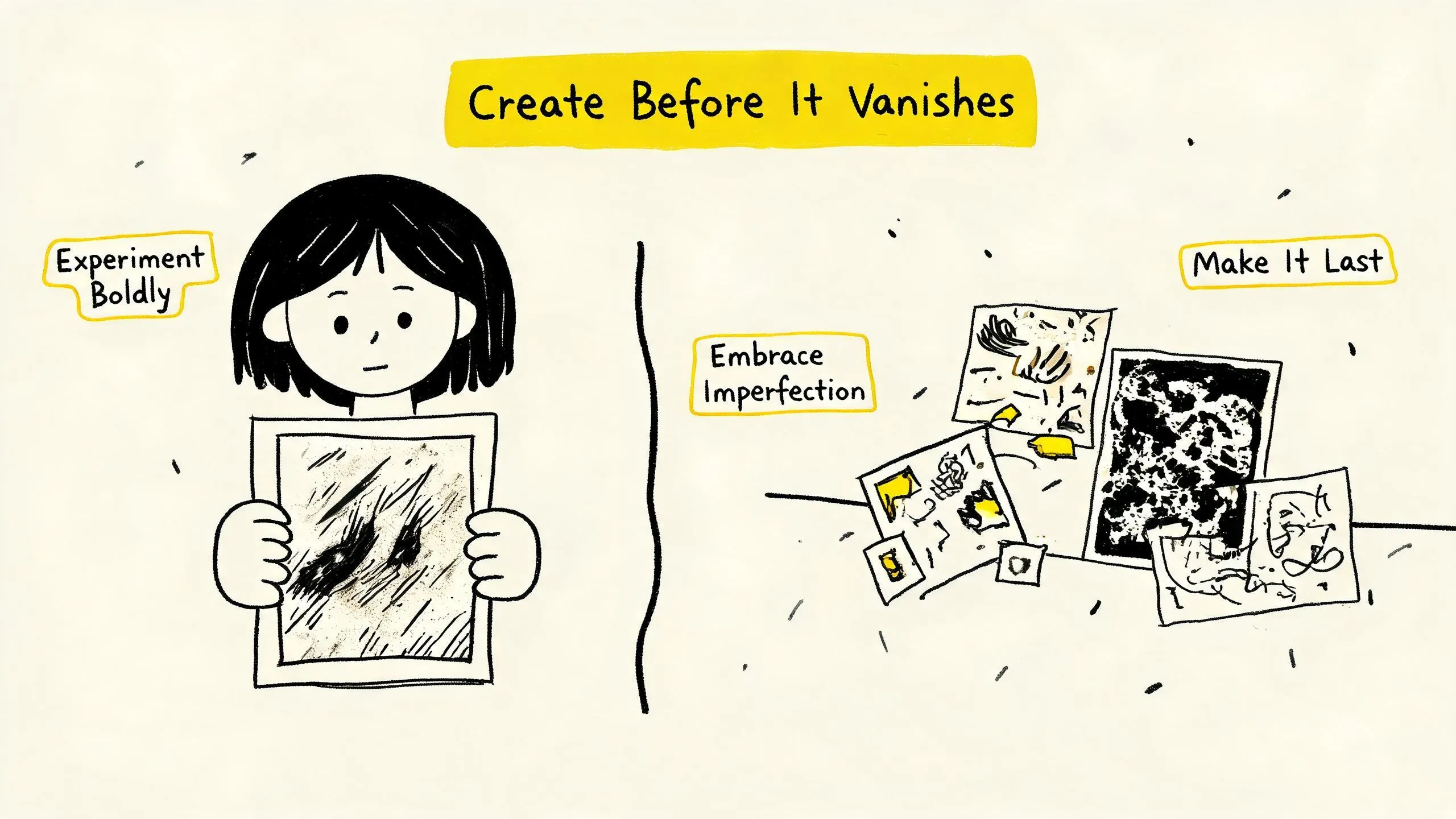
Peel-apart film is becoming an “endangered” photographic medium. The market reality is depleted stock and high prices. However, it is precisely this scarcity that has ignited unprecedented creativity within the community. From subtle interventions during development to complete reinvention of the film sheet itself, these 10 techniques are not just skills, but an attitude: pursuing infinite expression within finite conditions.
When you hold the last sheet of peel-apart film in your hands, do not hesitate. Use it to experiment, to make mistakes, to create unique images. Because in this era, every peel is a confrontation with disappearance, an attempt to capture eternity amidst the accidents of chemistry and physics.
References
- Where to Buy FP-100C Film in 2026 (Price Guide + eBay Tips)
- Fujifilm FP-100C Ends Production; Peel-Apart Film is Officially Dead
- ONE INSTANT – The World’s Only Peel-Apart Instant Film
- One Instant Blog – Supersense
- NEWS: Supersense Launches Cheaper ONE INSTANT DIY Peel-Apart Instant Packfilm Kit
- How to Break My Heart: SuperSense One Instant Peel Apart Film Review
- The GOOSE: Reviewing the Polaroid 600SE
- Cold Weather and Instant Films – Figital Revolution
- Freezing Fuji FP-100C Instant Film – Figital Revolution
- Freezing Fuji FP 100C – One Year Later – Figital Revolution