Film Therapy Prescriptions: Shooting Rituals and Community Remedies for Four Emotional States
In the digital age, we are accustomed to unlimited storage, instant previews, and one-click deletion. This convenience sometimes brings new anxieties: attention
In the digital age, we are accustomed to unlimited storage, instant previews, and one-click deletion. This convenience sometimes brings new anxieties: attention fragmented by information overload, a sense of accomplishment dissipating in “shoot and forget,” loneliness breeding in virtual socializing, and creative passion withering in the pursuit of perfection. Film photography, with its inherent “limitations” and “sense of ritual,” offers us an actionable therapeutic plan. It’s not just a slogan to “slow down,” but a “prescription” that can be integrated into daily life. This article will provide specific film shooting rituals and community practice guides for four common emotional states—anxiety, burnout, loneliness, and creative block—helping you transform film photography into a powerful tool for managing emotions and rebuilding connections.
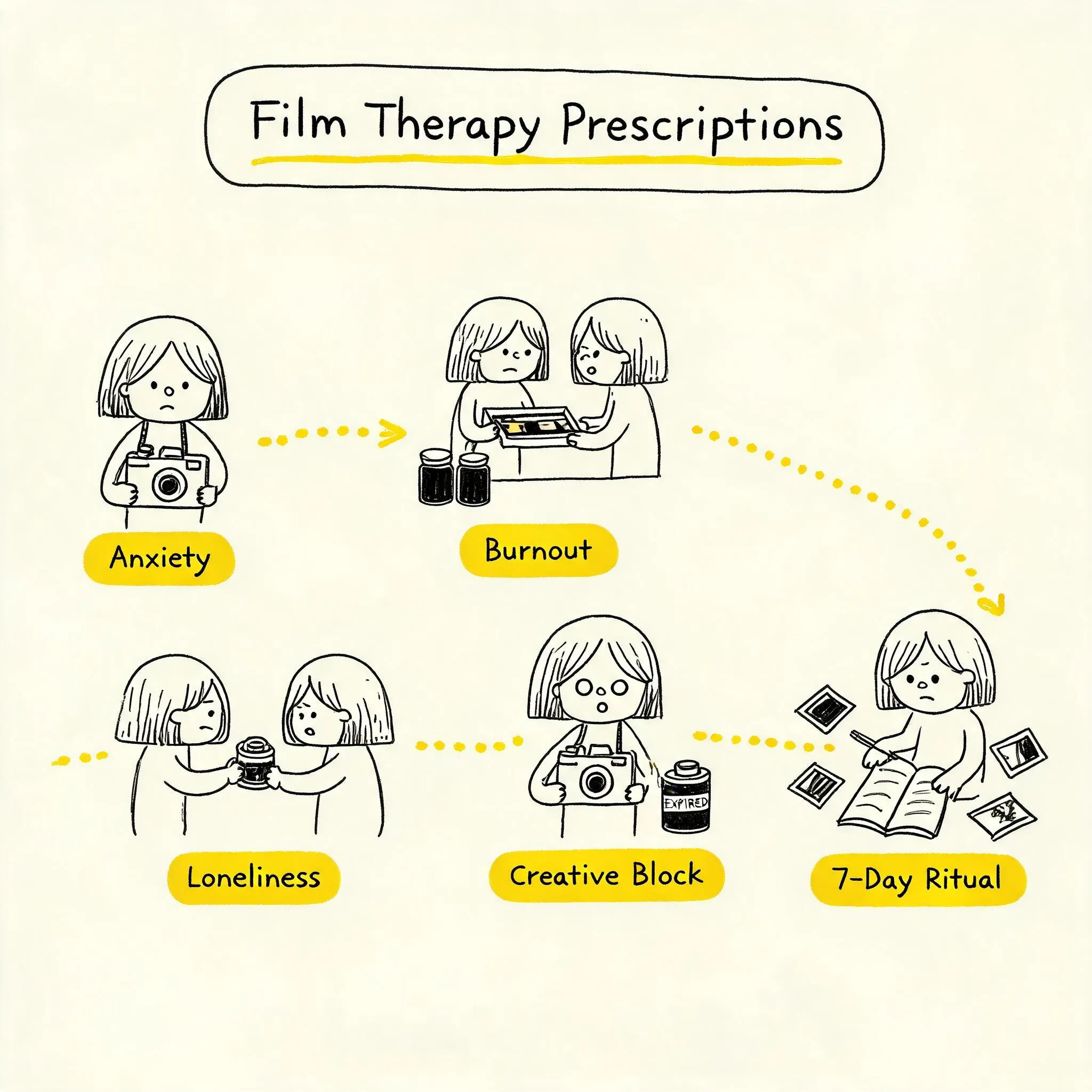
I. Moments of Anxiety: Rebuilding Attention with 36 “Non-Deletable” Frames
One core experience of anxiety is scattered attention and excessive worry about the future. Our minds jump among countless possibilities, struggling to stay grounded in the present. Film photography, especially its physical finitude, naturally becomes an anchor against this scattering.
How Film’s Limitations Become an Attention Anchor
Unlike the near-infinite shooting capacity of digital cameras, a standard roll of 35mm film typically offers only 36 (or 24) exposures. This means every press of the shutter is an irreversible commitment. This “non-deletable” characteristic forces us to think and choose more deliberately before shooting. Analog.cafe author ninetwentysix shared his personal experience: on a road trip in Sweden, he took 2,500 photos with a digital camera but felt immense pressure to “edit them all.” After switching to film, he found that “the 36-frame limit helped me focus on the essentials and enjoy the moment” . This limitation actually enhanced creative satisfaction, as the success rate—“ten good shots out of thirty-six”—became acceptable, even enjoyable.
An Fstoppers review also points out that the limited exposures, inability to instantly review results, and developing costs of film photography are precisely what constitute its therapeutic value. They “force photographers to be more deliberate and thoughtful,” and this practice of deliberation can transfer to other areas of life, promoting better emotional regulation .
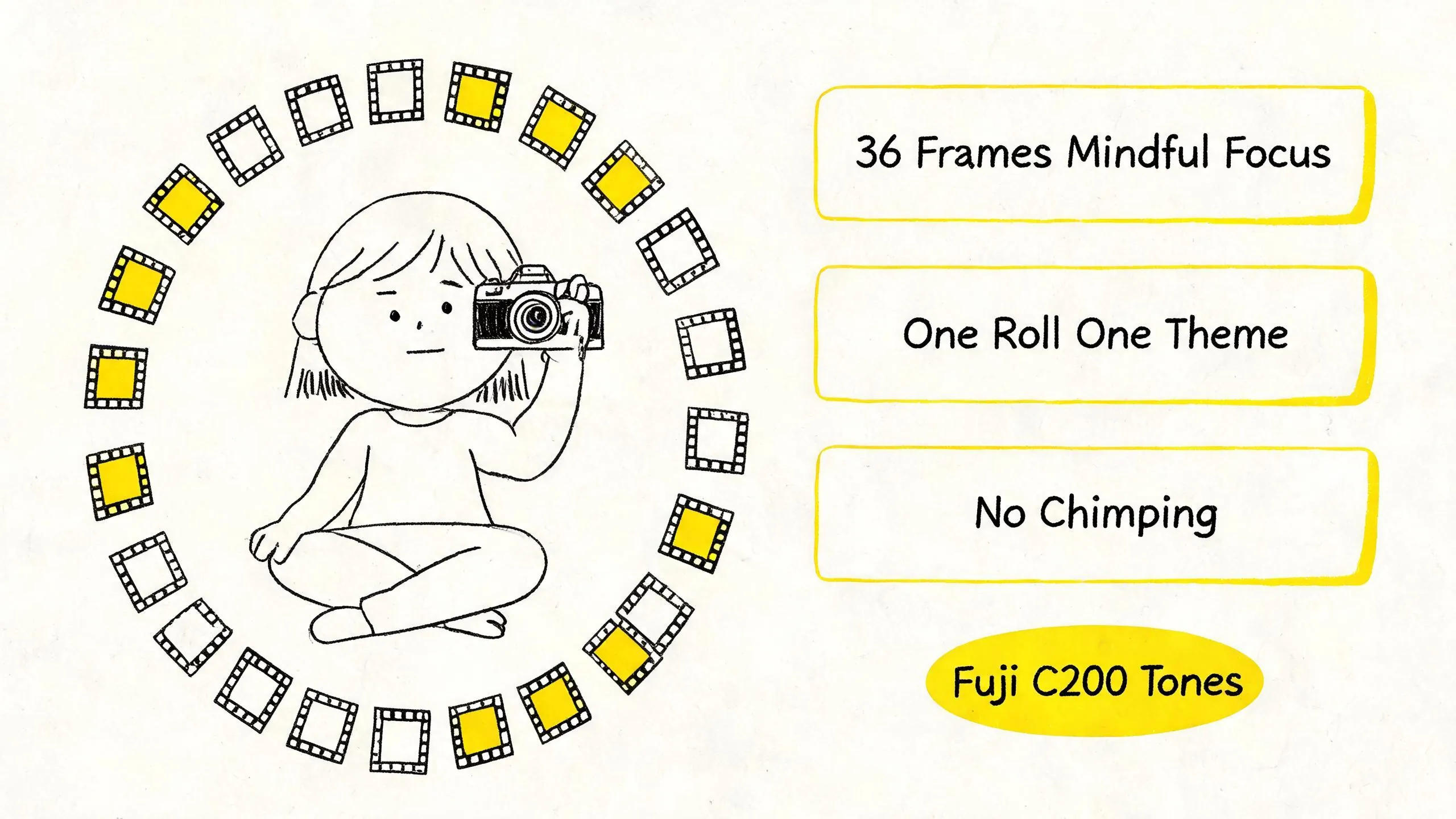
Prescription: “Mindful Shooting” with One Roll, One Theme
Core Ritual: Choose a roll of film (36 exposures recommended) and focus exclusively on one extremely simple, fixed micro-theme throughout the entire roll. Examples: “the plant on my desk,” “all the doors I pass today,” “light and shadow on the window.”
Steps:
- Choose the Roll: For anxious moments seeking comfort, Fujifilm C200 is a good choice. Its tones are praised for “soft colors, warm greens, and a classic everyday film feel,” with gentle highlight handling that evokes a natural sense of nostalgia . Its good rendering of greens, yellows, and reds can make mundane daily details moving .
- Choose the Camera: Use any familiar, simple-to-operate film camera. The key is to let the camera be an extension of your observation, not a burden to your thoughts.
- Shoot: During the process of shooting these 36 frames, absolutely no chimping (reviewing shots). The review function on digital cameras constantly interrupts the “shoot-observe” cycle, pulling you back into judging results. Film lets you focus on the act of “seeing” itself.
- Mindset: Treat shooting as a mindfulness practice. Research shows that focusing on capturing images can shift attention away from worries and cultivate calmness . You are not “creating masterpieces,” but engaging in a focused observational meditation.
Course of Treatment: After completing the entire roll, wait for developing. This waiting period itself is part of the healing; it delays gratification and allows you to form a deeper connection with the focused memory of the shooting moment.
II. Burnout: Rebuilding the Achievement Loop with Developing Rituals
Professional or creative burnout is often accompanied by a断裂 in the sense of achievement. In digital workflows, the process from pressing the shutter to seeing the final image on screen is brief and abstract, lacking a tangible, effort-required closed loop. Film developing, especially home developing, can rebuild this “handcraft ritual” and sense of achievement.
Developing: A Miracle Born from Chemical Reactions
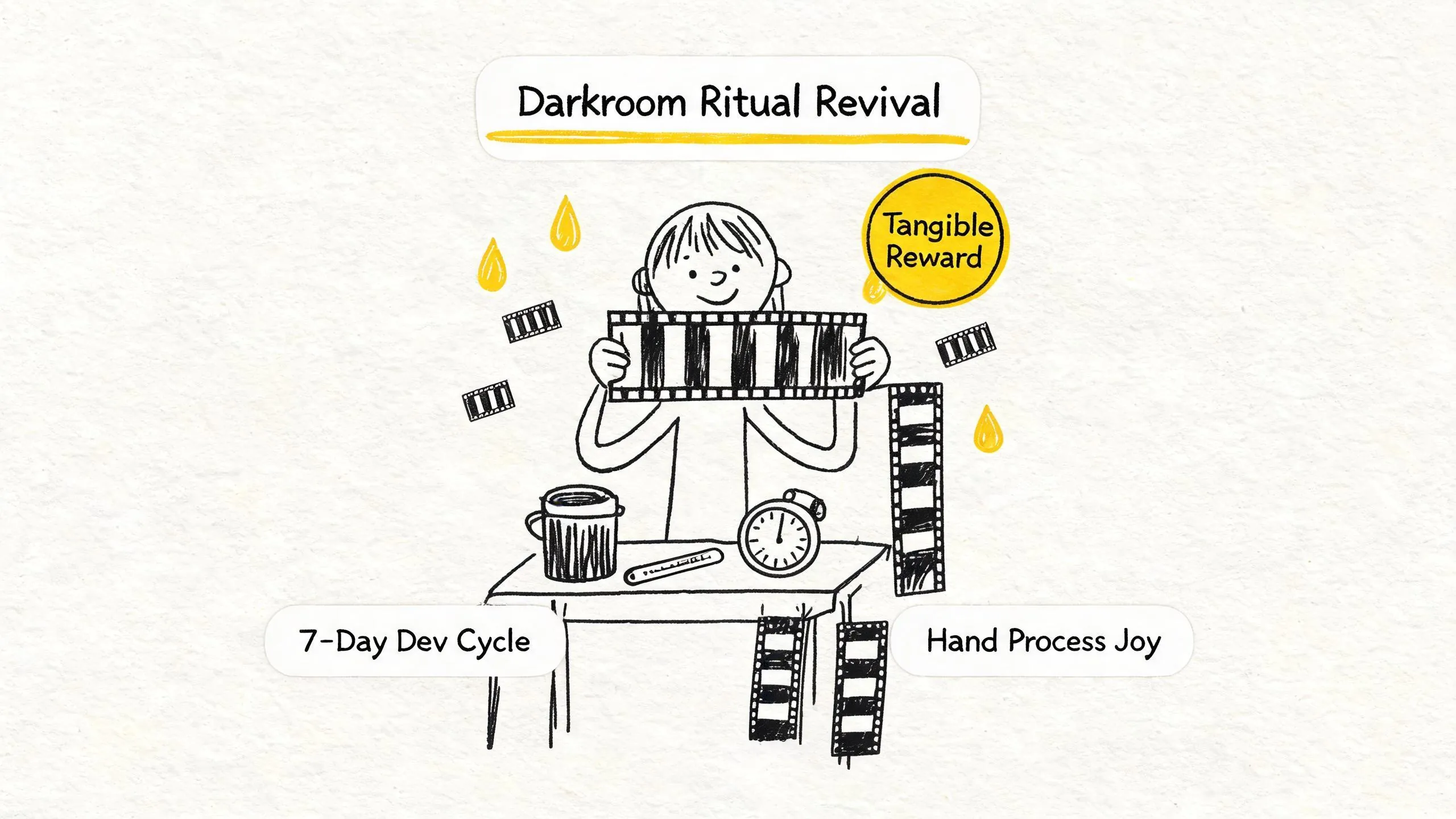
Film developing is a physicochemical process that transforms invisible latent images into visible ones. Fstoppers describes the manual developing process as a “therapeutic ritual”: the rhythm of darkroom developing, the precise timing of chemical processes, and the gradual emergence of the image in the developer “can produce a profound sense of wonder and accomplishment” . ninetwentysix, after trying home developing, reflected: “After learning to develop and print film myself, I could complete tasks seriously again. A mistake might mean ruined film or wasted paper, so I scrutinized each photo multiple times—each review re-lived the moment of capture.”
Prescription: Build Your “Developing Lab” at Home
Core Ritual: Set a “7-day cycle” from shooting to final print, and complete one home developing session within that cycle. Treat this process as a complete mini-project.
Steps:
- Choose a Developing Process:
- C-41 Color Negative: This is the most common color negative developing process. The key to home developing is precise temperature control. Modern home kits often use a sous vide machine to maintain chemicals at a constant temperature of around 38°C . The process roughly involves: pre-soak → loading the reel (done in a changing bag) → development → bleach-fix → wash → stabilization → drying.
- Black and White Film: Has a lower barrier to entry. Standard developing temperature is room temperature (20°C), requiring no heating equipment, and has a higher tolerance for error, making it ideal for experiencing the developing ritual . Brands like ILFORD provide detailed home developing guides in Chinese, covering everything from equipment lists to step-by-step instructions.
- Prepare the Environment: Designate a corner at home, even just a sink, and prepare tools like a developing tank, measuring cups, thermometer, timer, etc. Platforms like Taobao offer “photography developing societies” selling home developing kits, described as a “gentle rebellion against digital anxiety” .
- Execute the Ritual: Follow the process strictly, paying attention to the time and temperature of each step. As the image gradually becomes clear on the negative, and the first wet negative is hung to dry, that sense of hands-on accomplishment is something digital workflows cannot provide.
- Track the Cycle: Record the date from shooting the first frame to scanning/printing the first photo. Stabilizing this cycle to around 7 days can help you rebuild a sense of controllable, rhythmic small goals during burnout.
Course of Treatment: For beginners, it’s recommended to start with black and white film to experience the ritual of developing. Once proficient, you can challenge the C-41 process. Even if you don’t develop at home, choosing a reliable lab (like FilmNeverDie mentioned in the video ) and patiently waiting several days can also, to some extent, rebuild this closed loop of delayed gratification.
III. Loneliness: Building Real Connections with Film Communities and Negative Swaps
Loneliness in the digital age often exists in a paradoxical form: we have countless online “friends” but lack deep, real connections. Film photography communities, with their unique shared experiences—waiting, uncertainty, cherishing the physical—become fertile ground for building these real connections.
The Unique Bond of Film Communities
An empirical study published in Scientific Reports in 2025 (sample size N=600) found that film photography participation significantly improved participants’ psychological well-being (increased self-esteem, reduced stress) through mediating pathways of nostalgia and mindfulness, and positively predicted a sense of community belonging. Latent class analysis identified four types of film photographers, among whom “Social Connectors” (about 25%) had the highest sense of community belonging. Qualitative interviews revealed that it was precisely “offline meetups, sharing prints, talking for hours… that’s where real bonds are formed” .
Online communities are equally important. For example, the #BelieveInFilm community, with over a decade of history, is founded on the core principle of “people helping people” rather than showing off gear. Founder Gordon Boddition, during personal lows and creative blocks, found that this community helped him “break through the block and discover new ways to create” .
Prescription: Participate in a “Film Swap” or Offline Meetup
Core Ritual: Proactively initiate or participate in a social activity centered around film, transforming personal creation into a shared experience.
Action Plan:
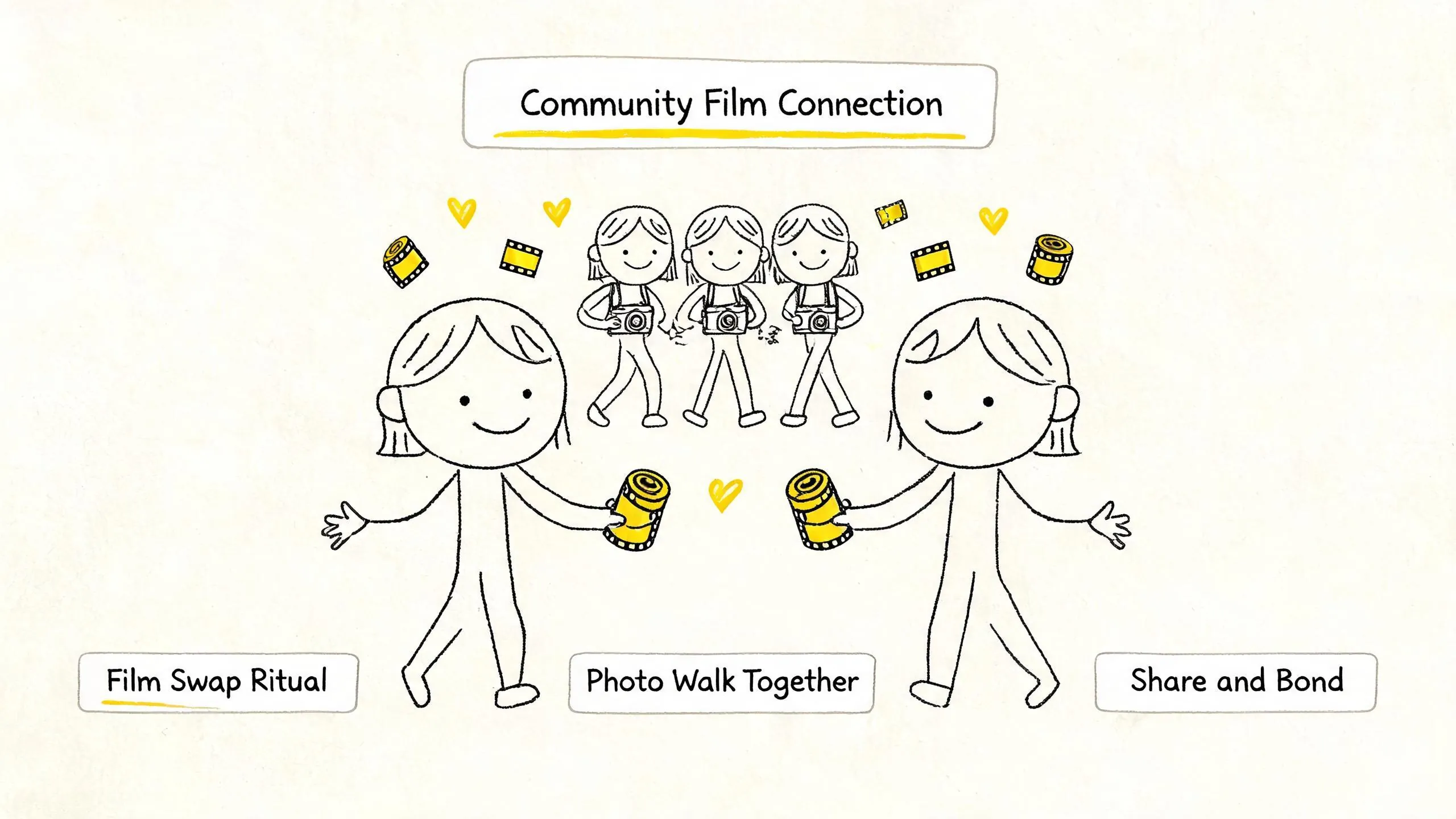
- Film Swap: This is a highly ritualistic collaboration. Two (or more) people each shoot a roll of undeveloped film, then swap rolls, with the other person responsible for developing. This process produces unpredictable double exposures, with its core appeal lying in “trust and the shared experience of waiting” . You can arrange this with a distant film friend or initiate a swap invitation in an online community.
- Offline Film Meetup (Photowalk): Look for local photography communities or cultural spaces. For example, the San Francisco Public Library hosts bilingual Photowalk events , and the East Bay Photo Collective in the East Bay holds free open photowalks on the first Sunday of each month . In China, many cities also have spontaneous film groups organizing street photography outings. The focus when participating isn’t on taking great photos, but on walking, observing, and exchanging ideas with fellow enthusiasts, sharing different perspectives on the same scene.
- Join Online Communities: Use hashtags like #BelieveInFilm on Instagram, or find film photography groups on Weibo, Douban, or Bilibili. Share your work and process, participate in discussions. Remember the community’s principle of goodwill: “Be nice.”
Course of Treatment: Start with a small, low-pressure activity. It could be arranging with a friend to shoot a roll together on the weekend, then swapping for developing. The key is taking the first step from “shooting alone” to “shared experience.”
IV. Creative Block: Breaking Perfectionism with “Expired/Unknown Rolls”
Creative blocks often stem from an obsession with “good photos,” excessive control over technique, and fear of results. We fear failure, fear imperfection, and thus hesitate to press the shutter. Intentionally using expired film or unfamiliar camera systems is an excellent “prescription” for breaking these perfectionist shackles.
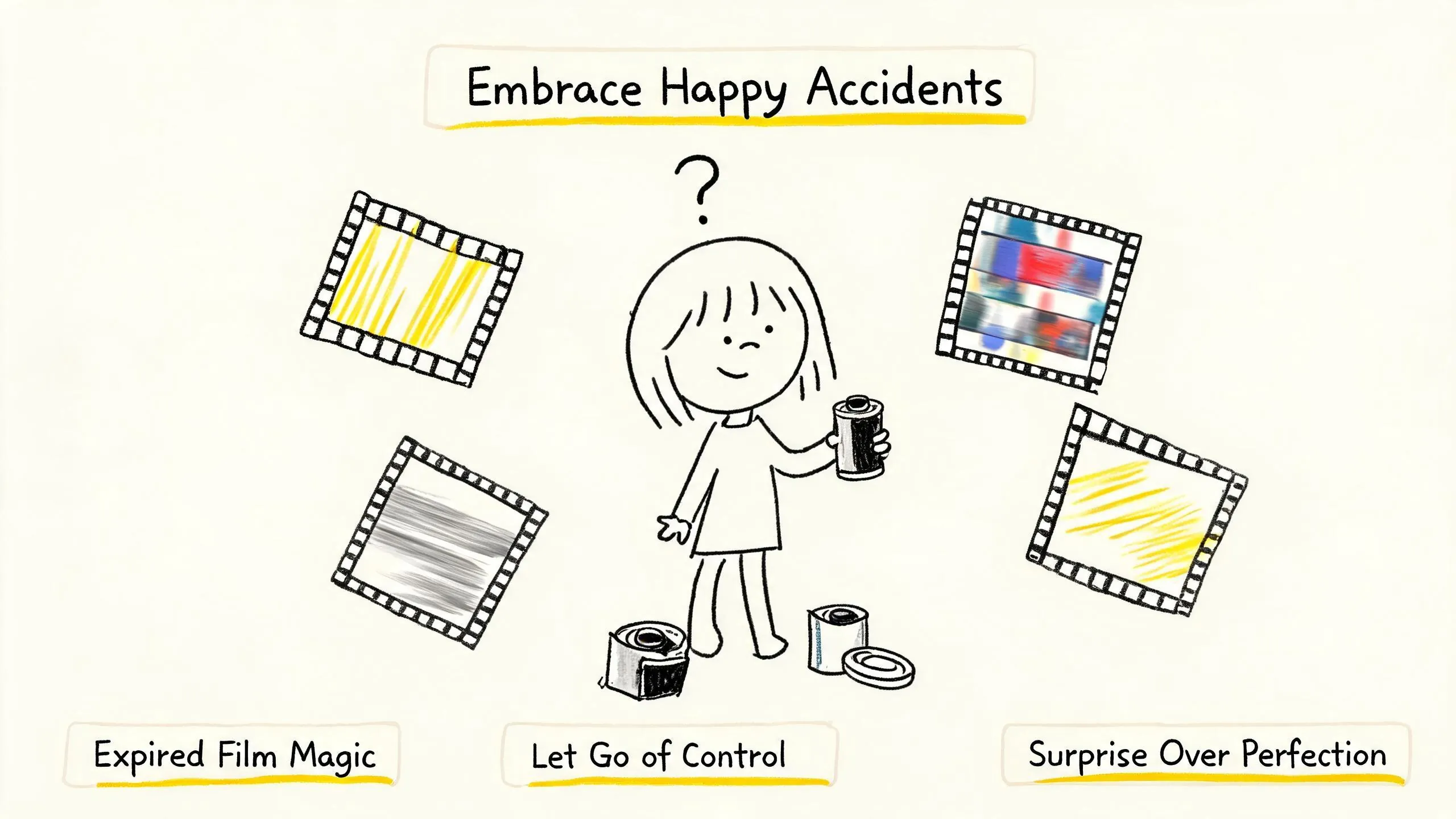
Embracing the Uncontrollable: The Surprise Philosophy of Expired Film
Expired film is the ultimate “anti-perfectionism” tool. Wesley wrote in his in-depth article: “If you’ve ever felt suffocated by the pursuit of ‘perfection,’ expired film is your unexpected antidote. It doesn’t care about your creative plans, your meticulously planned exposure—it’s here to surprise you.” He shared a roll of expired Ektachrome 64T slide film from 1999, which required shooting at a very low ISO of 16, yet some of the resulting images became favorites in his portfolio.
Technical Notes: Using expired film requires some skill. ExpertPhotography summarizes the general rule as “reduce one stop of ISO for every ten years expired” (e.g., a 400 ISO film expired for 10 years should be shot at 200 ISO) . Additionally, expired film may bring color shifts, increased grain, and reduced contrast. The Darkroom suggests expired film is suitable for personal walks, test shots, street photography, and other re-shootable scenarios, and should be avoided for must-document moments like weddings .
Prescription: Launch a “Random Creation Experiment”
Core Ritual: Proactively relinquish control over the final outcome, making the shooting process itself the goal.
Steps:
- Choose an “Uncontrollable” Medium:
- Expired Film: Obtain a roll of expired film from a reliable source (like some film shops or community swaps). Accept its uncertainty and treat it as a co-creator.
- Unfamiliar System: If you’ve always used a 35mm camera, try a roll of 110 film or rent/borrow a medium format camera. Unfamiliar operation and perspectives can break habitual thinking.
- Set a “No-Goal” Task: Don’t set specific shooting themes or technical goals. Just take the camera out, follow your intuition, and record whatever attracts you.
- Adjust Your Mindset: View potential “failures” (like light leaks, severe color casts, blurriness) as “happy accidents.” Fstoppers points out that appreciating these unexpected results helps cultivate tolerance for uncertainty, which is a key mechanism in treating perfectionism . Motion blur might create dynamism; overexposure might produce a dreamy texture.
- Share Your “Accidents”: Share the developed photos full of unexpected effects in film communities. You’ll find these imperfect images often spark the most sincere resonance and interesting discussions.
Course of Treatment: Schedule using an expired roll or unfamiliar system as a regular “Adventure Day” on your creative calendar. Its primary task isn’t to produce masterpieces, but to give your taut creative nerves a relaxing massage.
V. Design Your Own Film Therapy Week: A Replicable 7-Day Practice Template
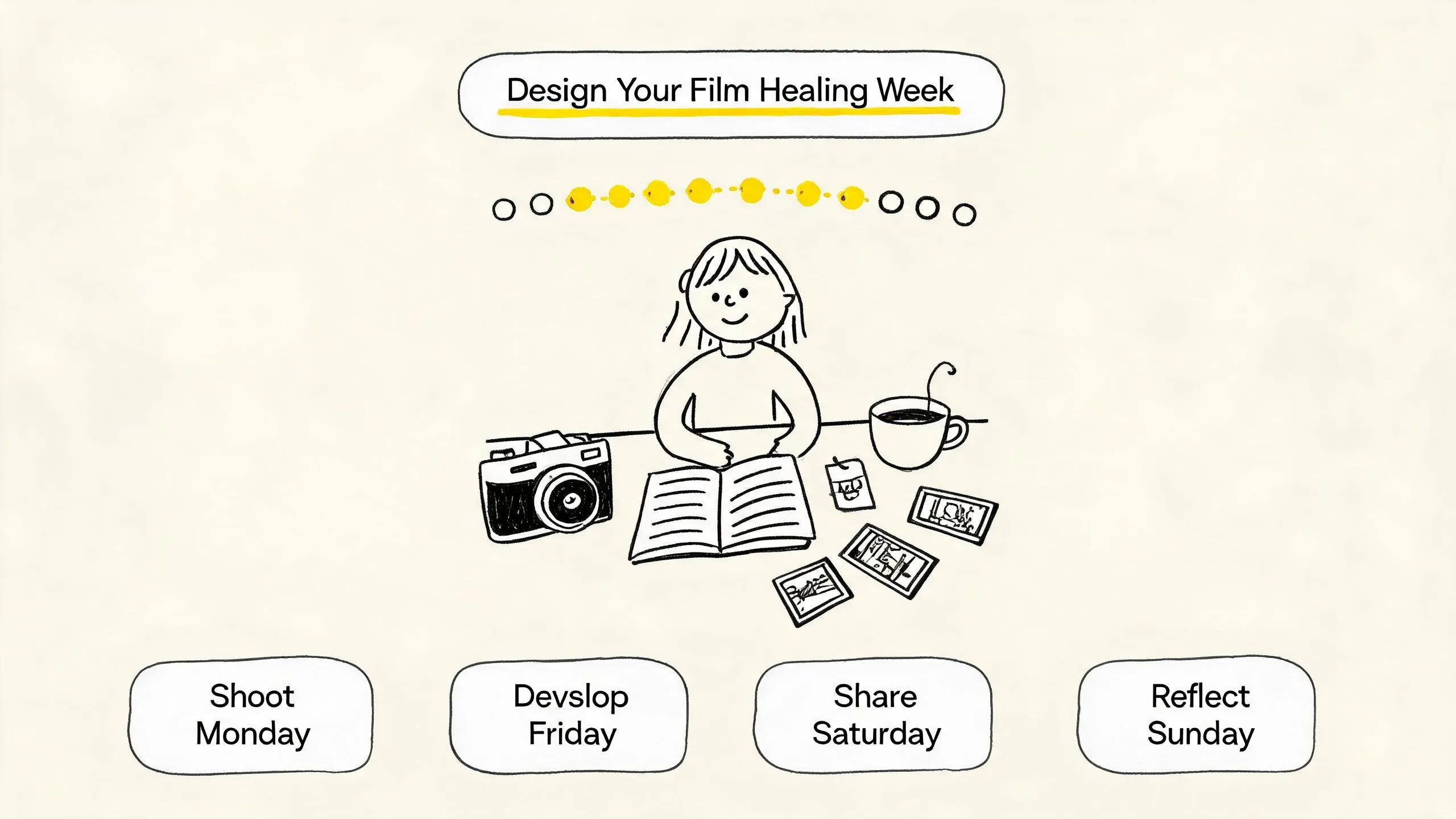
Integrating the above “prescriptions” into life requires a bit of structure and rhythm. Here is a one-week practice template you can adjust based on your emotional state and schedule.
Daily Rhythm Suggestions
- Monday (Launch Day): Choose this week’s “emotional prescription” (corresponding to anxiety/burnout/loneliness/block). Load the film and take the first shots. This could be a 30-minute “mindful observation walk.”
- Tuesday to Thursday (Immersion Days): Shoot for 15-30 minutes each day, strictly following this week’s set ritual (e.g., only photograph plants, no chimping). Record simple emotional keywords during shooting (e.g., “calm,” “irritable,” “focused”).
- Friday (Ritual Day): Complete shooting the entire roll. If you chose to develop at home, today you can develop. If sending to a lab, organize the film and prepare to drop it off. This is an important ritual node, symbolizing the completion of “investment.”
- Saturday (Connection/Surprise Day): Participate in a community activity (like an offline meetup or online sharing), or conduct a “random creation experiment” (like using expired film). The focus is on interacting with the outside world or embracing uncertainty.
- Sunday (Review Day): Pick up the developed negatives/prints. Scan or select frames to print. Spend time carefully looking at each photo, recalling the scenes and feelings during shooting.
Film Diary Writing Prompts
When organizing photos each Sunday, you can briefly answer the following questions to form your “Film Therapy Diary”:
- What was my primary emotional state this week? Did the shooting process help me alleviate or understand it?
- Which photo (or photos) best represents my mood this week? Why?
- In the developing/waiting/sharing process, which step resonated most with me (sense of achievement, surprise, connection)?
- What different “prescription” or ritual would I like to try next week?
Tracking and Feedback
After persisting for a few weeks, review your film diary and photos. You might discover interesting correlations: for example, on anxious days, the roll shot of plants always has particularly soft tones; after completing home developing during burnout, creative efficiency noticeably improves in the following days. This tracking itself is a form of deep self-care.
The healing power of film photography lies within these rolls of film, these shutter clicks, these cans of developer, and these communities of sincere sharing. It doesn’t require you to become a photography master; it only invites you to become a more focused, patient, and willing observer—connected to yourself and others. Now, take out your camera, choose a roll of film, and start writing your own healing prescription.
References
- How Photography Helped My Mental Health: Especially Analogue
- Why Photography Could Be the Mental Health Boost You Never Knew You Needed
- The Healing Lens: How Therapeutic Photography Transforms Mental Health
- Analog photography enhances identity, well-being, and social connection, in Southeastern China
- #BelieveInFilm — a Film Photography Community
- Lomography Film Swap Challenge (Part 1)
- Why I Love Shooting Expired Film (and You Should Too)
- How to Shoot with Expired Film (For Creative Results)
- A Quick Guide to Expired Film, Old Found Rolls, and Negatives
- C-41 Process: Film Development Explained