One Roll, One City: A Practice of Spatial Narrative to Unify an Entire Roll
In the world of film photography, "one roll, one theme" is the first step for many enthusiasts moving from casual snapshots to intentional creation. It means yo
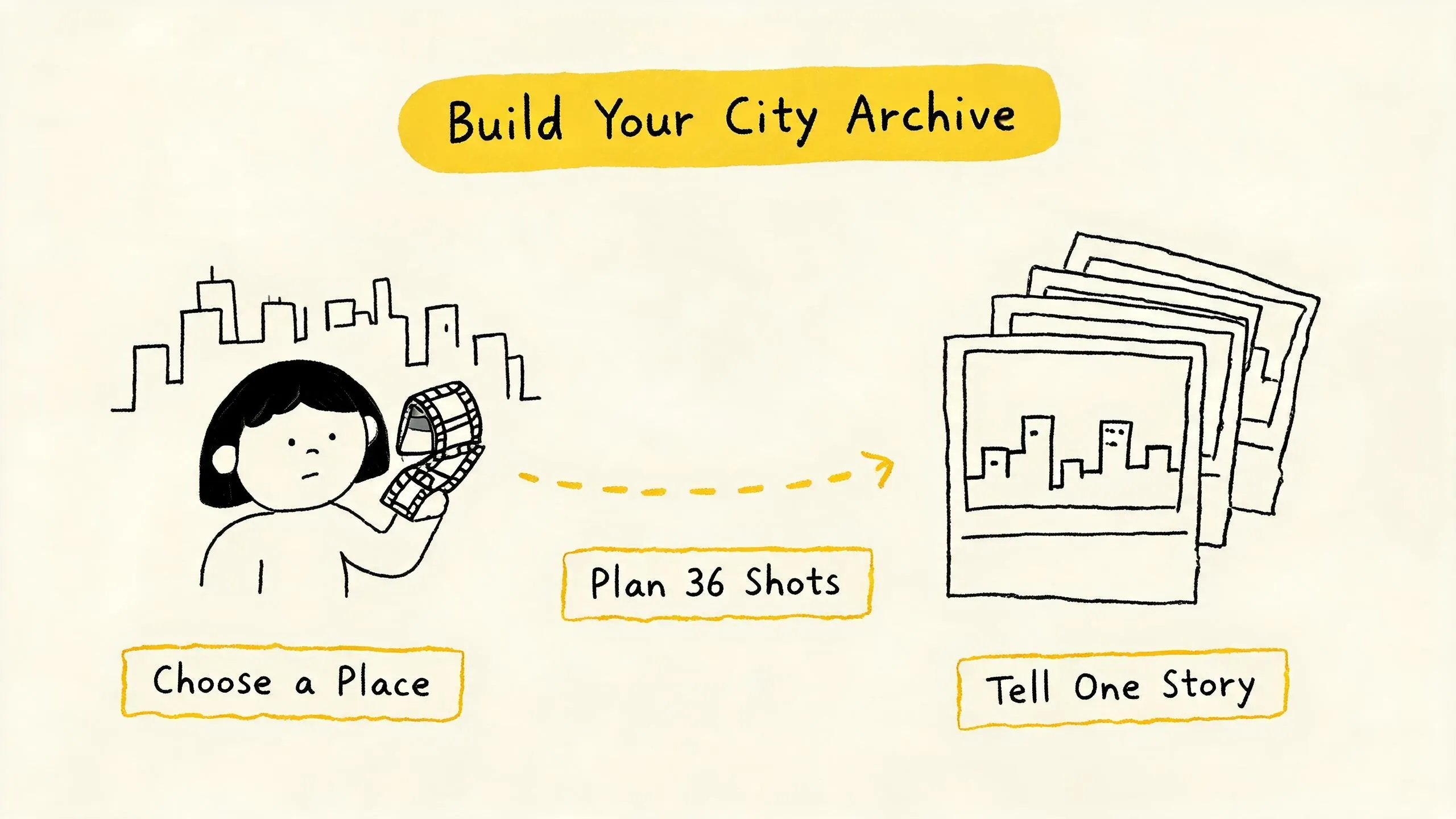
In the world of film photography, “one roll, one theme” is the first step for many enthusiasts moving from casual snapshots to intentional creation. It means you no longer press the shutter aimlessly, but use a clear concept to govern the entire roll of 36 exposures. However, this theme can be abstract, like “light and shadow,” or concrete, like “blue.” Today, we explore a more concrete and narratively compelling advanced approach: Spatial Narrative. It no longer settles for “what to shoot,” but delves into “where to shoot,” making “that place” itself the protagonist of the story.
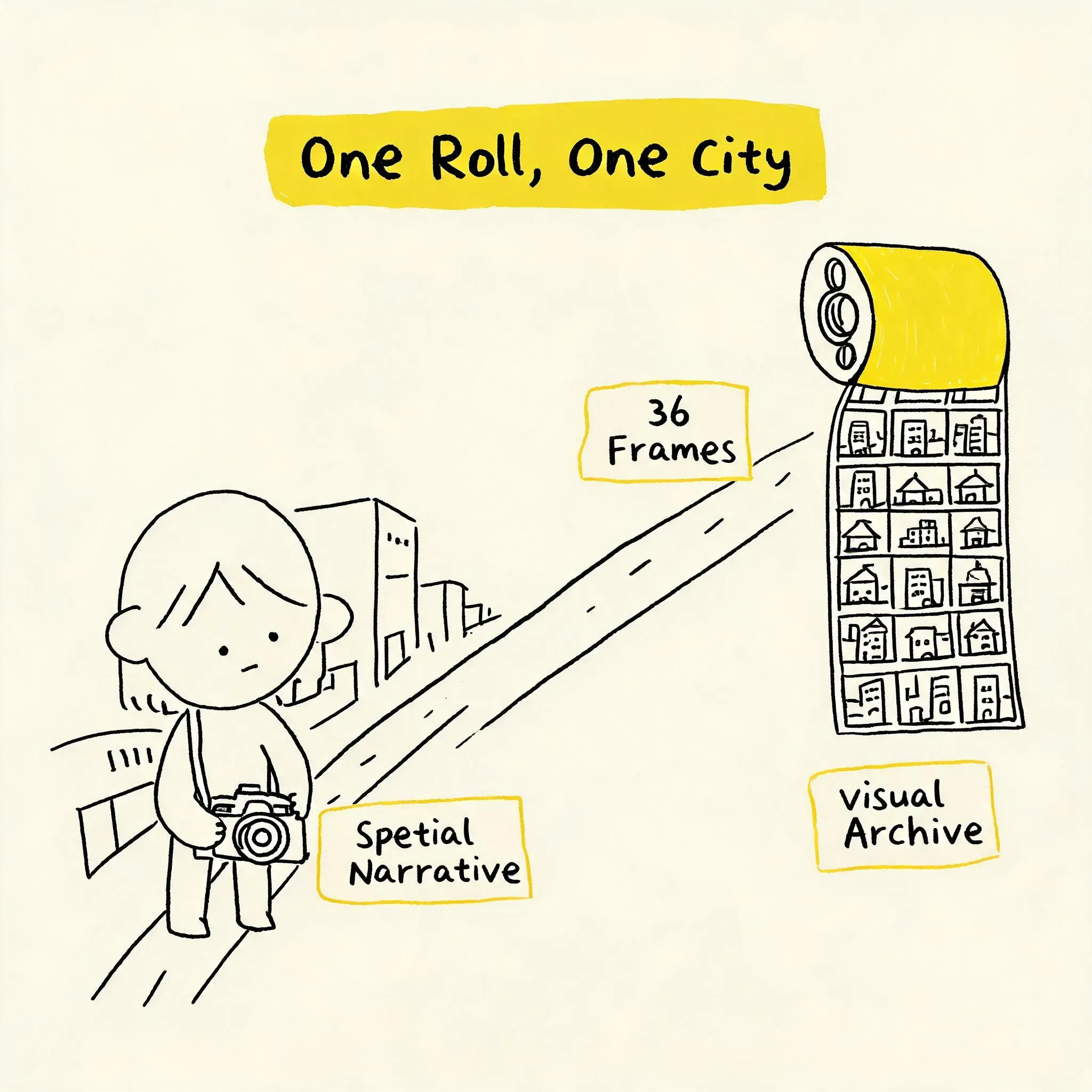
Imagine dedicating a roll of film to a city, a neighborhood, or even a single street. Your 36 exposures become 36 gazes, 36 slices of that specific space. Ultimately, when the roll is developed, you don’t get a scattered pile of photos, but a visual archive of that space—a “photo essay” about a place, directed by you. This article will deconstruct this creative method, from mindset shift to practical planning, providing you with a replicable workflow. So next time you travel or wander your city, you can use one roll of film to tell the story of a city.
I. Mindset Shift: From “What to Shoot” to “Where to Shoot”
Before taking action, we first need to make a mental leap.
Spatial Narrative vs. Thematic Narrative: Differences and Complements
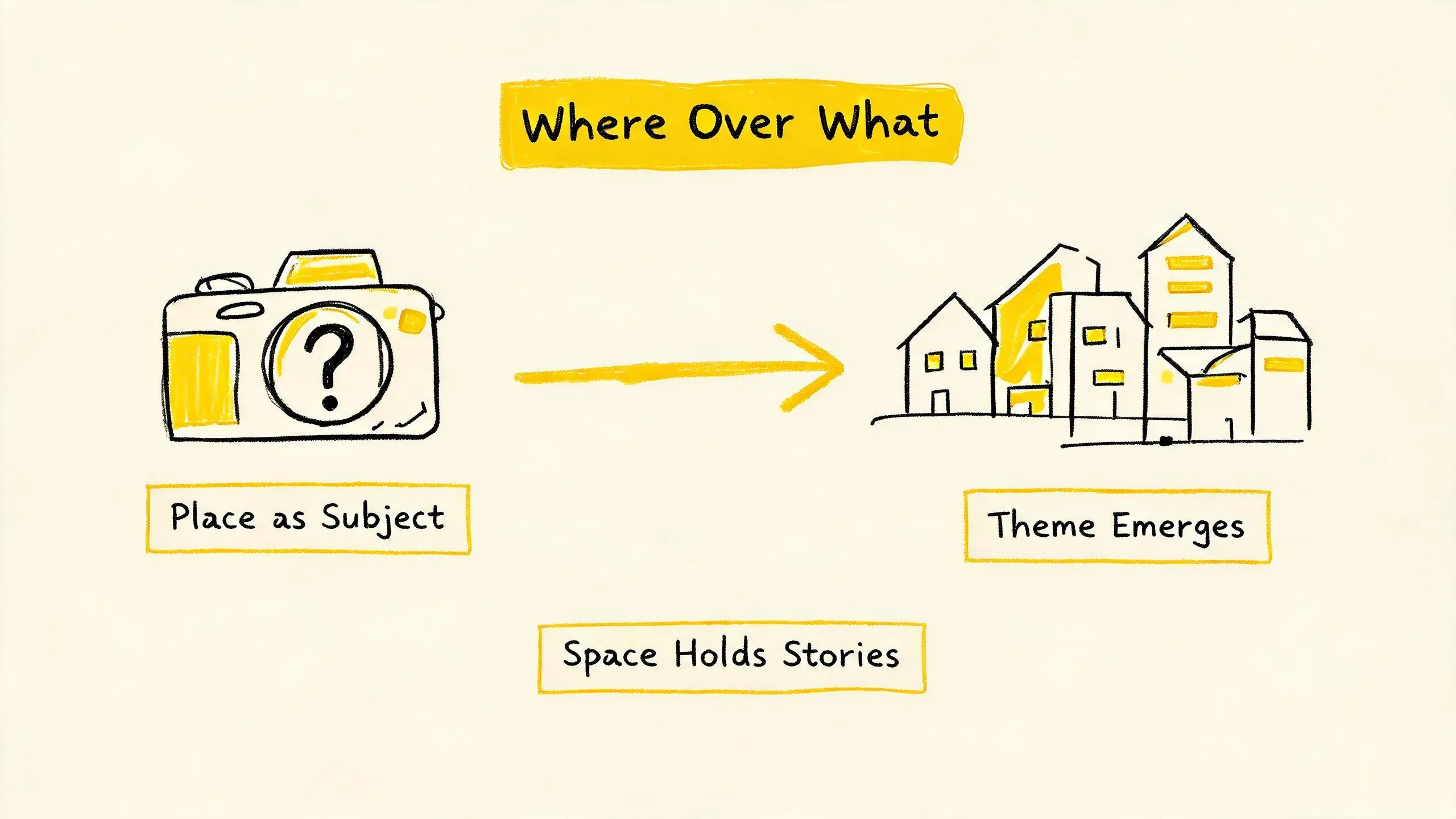
Traditional “thematic narrative” uses a core concept as its thread. For example, if you decide to shoot “loneliness,” you will seek out scenes that express that feeling wherever you go: an empty bench, a solitary pedestrian, a reflection in the rain. Spatial narrative is the opposite; its core thread is the geographical space itself. If you decide to shoot “Shanghai’s Longtang (alleyways),” then all your viewfinders will be aimed at that specific space. You will focus on the architecture, the play of light and shadow, the traces of life, and the people within it. The theme is internal, while the space is external and predetermined.
The two are not opposites but excellent complements. An outstanding spatial narrative work will inevitably contain rich themes. As you continuously observe a space, its unique atmosphere, history, and human themes will naturally emerge. The space is the vessel; the theme is the liquid flowing within it.
Why is Space a Natural Thread for Film Creation?
The physical limitation of film photography—typically 36 exposures per roll—transforms from a “shackle” into a “creative engine” at this moment. Faced with a vast city, the limited number of frames forces you to make choices and sacrifices. You cannot, nor do you need to, record everything. This limitation fosters intentional observation. As photographer Rodrigo Castro experienced while spending three days shooting the Brazilian island of Ilhabela with a single roll of Kodak Ultramax 400, the limited frames forced him to “choose subjects more slowly and deliberately,” and “shooting less, more slowly” led to “more precise, more detailed observation,” naturally slowing the pace of travel . The tension generated between the infinite space and the finite frames is the very charm of spatial narrative work—it forces you to dig deep into the layers of a space, rather than just scratching the surface.
II. Location Selection and Planning: Designing a Spatial Route for 36 Exposures
Spatial narrative is by no means an unplanned wander. On the contrary, it requires you, like a director, to meticulously design the “scenes” before shooting begins.
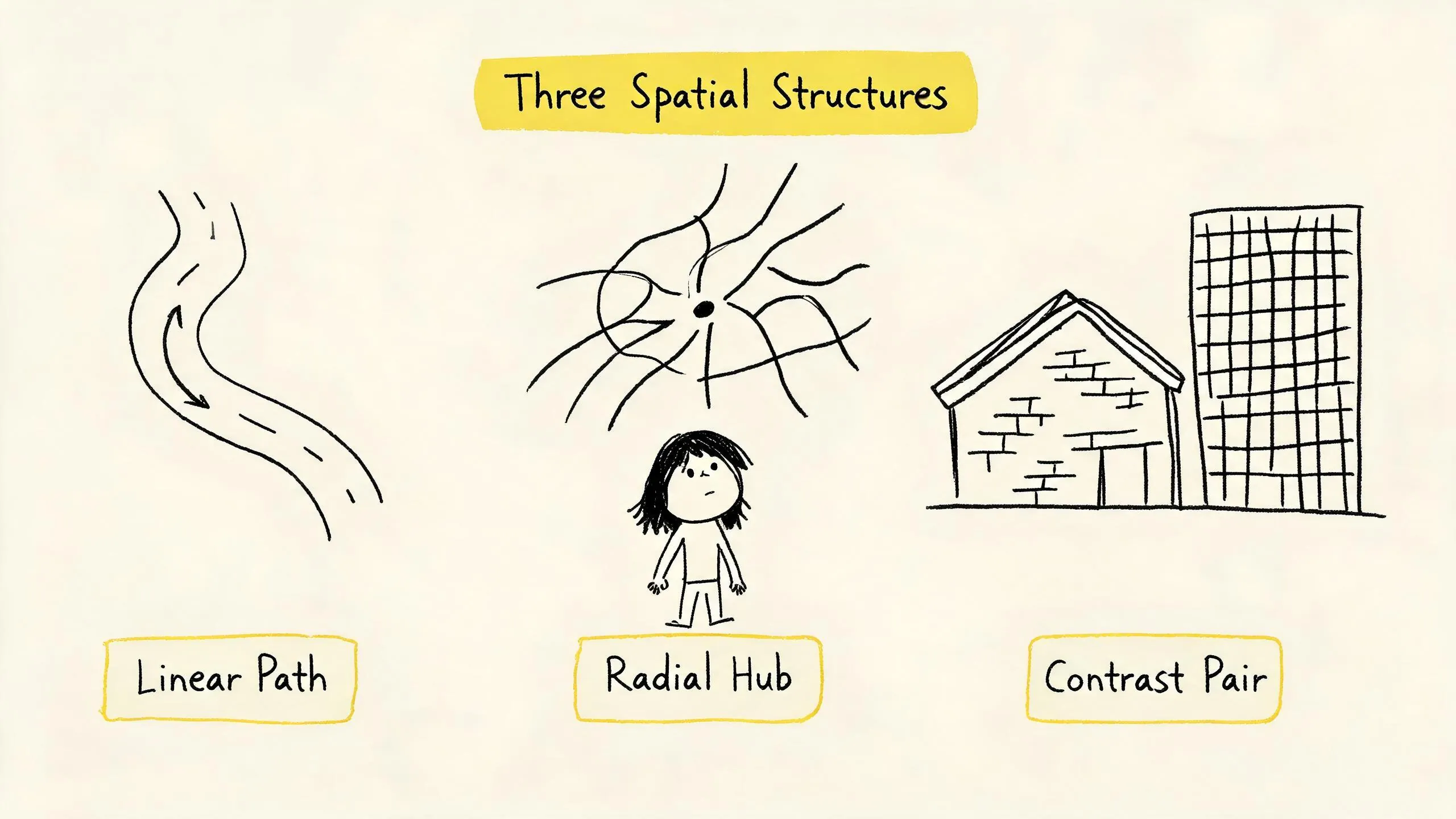
Three Spatial Narrative Structures
You can choose different spatial narrative structures based on the city’s character you wish to express:
- Linear Narrative: The most intuitive structure. Choose a path with a clear start and end point, such as a famous commercial street, a canal bank, or a subway line. Your 36 photos will unfold along this physical axis, recording the scenery, people, and changing details along the way. This structure is logical and easy to control.
- Radial Narrative: Choose a core landmark or area (like a square, a museum, a park), and then explore the surrounding neighborhoods from it as a center. Your photos will revolve around this core, featuring close-ups of the center point as well as the surrounding environment radiating outwards. This structure effectively showcases the layers and influence of an area.
- Contrast Narrative: This is the most dramatically tense structure. Consciously select two or more spaces that form a strong visual or atmospheric contrast for shooting. For example, a city’s new district versus its old town, bustling daytime streets versus quiet nighttime alleys, modern glass curtain walls versus weathered brick walls. By alternating between these contrasting spaces, your entire roll will naturally develop a dialogue and tension.
Map Marking: Your 36 “Potential” Shooting Points
Before setting out, open a map app (like Gaode or Google Maps) and visualize your chosen spatial structure on the map.
- Linear Narrative: Draw your route directly on the map.
- Radial Narrative: Mark the central point, then draw a few radiating directions or areas of interest around it.
- Contrast Narrative: Clearly mark the planned contrasting Area A and Area B.
Then, within each area or along the route, use the map’s marking function to pre-set approximately 36 “potential points” you deem worth shooting. These points can be buildings, intersections, small shops, park entrances, etc. This is not a rigid checklist, but your “ammunition depot of inspiration.” It ensures you won’t be lost on location while retaining the flexibility to adjust based on on-site light and inspiration.
Adding the Dimension of Time: Making the Space “Come Alive”
A space reveals completely different personalities at different times. Overlaying the dimension of time onto your spatial planning can greatly enrich your narrative.
- Changes in Light: The soft side light of early morning, the harsh overhead light of noon, the warm golden hour of dusk, the hazy artificial light of night. The same building tells a completely different story under different lighting.
- Rhythm of People: Empty streets in the early morning, bustling markets at midday, leisurely strollers in the evening, sparse late-night returnees. People are the soul of a space; their activities define its rhythm.
- Weather Impact: The brightness of a sunny day, the misty atmosphere of rain, the haziness of fog. Weather is the most powerful filter, capable of instantly changing a space’s tone.
When planning, consider: Which side of this space do I want my roll of film to primarily present? Is it the tranquility of morning light, or the vitality under the night sky? This will help you decide the shooting timeframe.
III. Controlling the Rhythm: Allocation Strategy for 36 Exposures
With your map and points in place, the next step is how to allocate these precious 36 exposures to give the entire roll a narrative arc, avoiding it becoming a mere “logbook.”
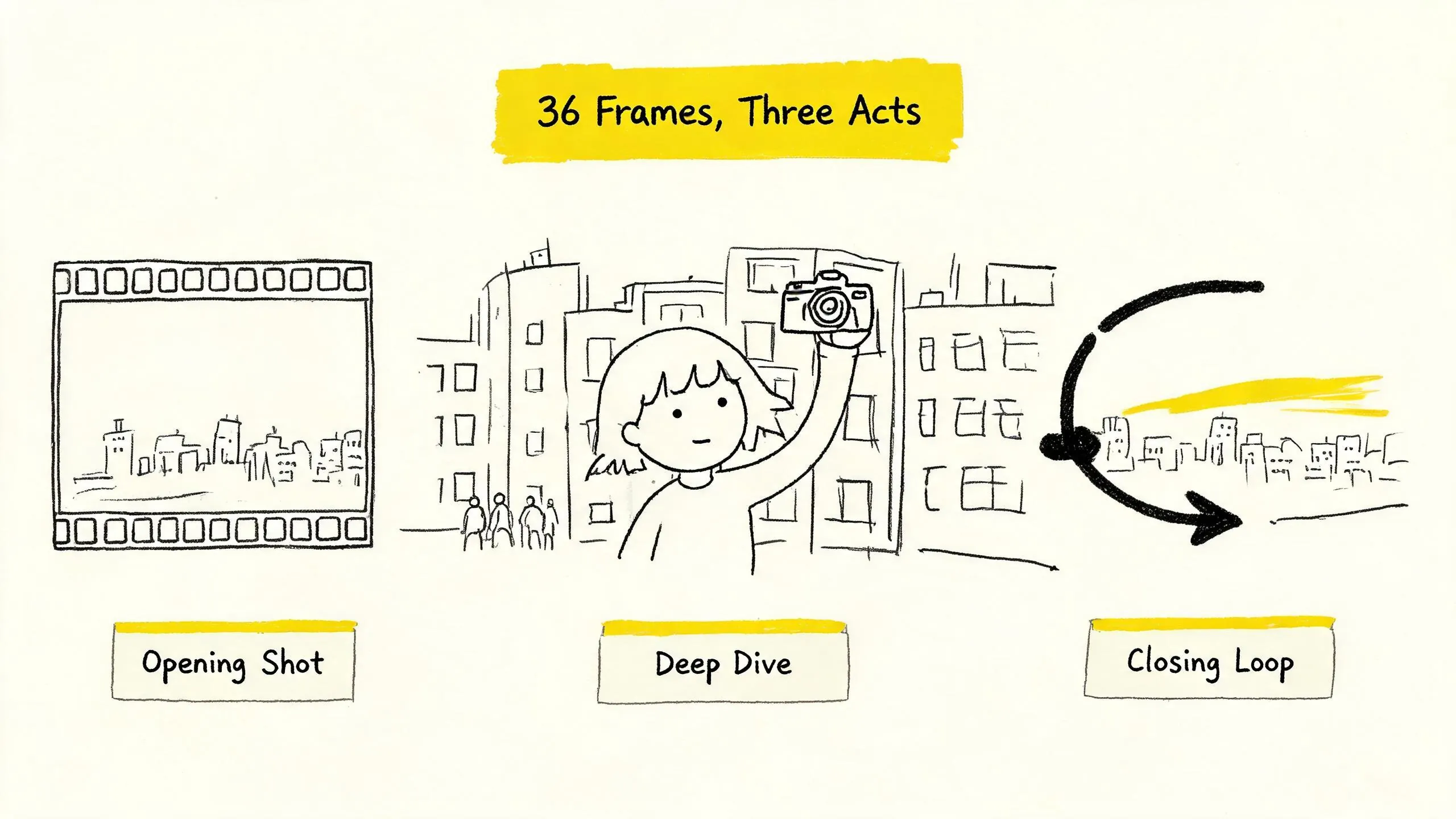
Opening (Exposures 1-6): Establishing the First Impression of the Space
The first few photos are crucial; they need to quickly immerse the viewer in the spatial context you’ve set. This is typically the Establishing Shot.
- It could be a wide shot showcasing the city skyline or the neighborhood’s panorama.
- It could be a symbolic close-up of a landmark entrance, a street sign, or a feature with strong regional characteristics.
- It could also be an atmospheric photo that immediately sets the emotional tone for the entire roll, like the light and shadow in a deep alley. The goal is to use the fewest frames to clearly convey “where this is” and “what it feels like.”
Development (Exposures 7-28): Diving into Details and Layers
This is the main body of the roll and your phase of deep exploration. You need to peel back the layers of the space like an onion.
- Alternate Macro and Micro: Don’t just shoot building panoramas or just door and window details. After establishing the environment with a wide shot, use medium shots or close-ups to capture interesting fragments: peeling paint, an old mailbox, a potted plant on a windowsill, patterns of light and shadow on the ground.
- Focus on “Human Traces”: Even if not photographing people directly, pay attention to traces of human activity: laundry hanging out, parked bicycles, goods on a stall, graffiti on a wall. These traces tell the stories happening within the space.
- Seek Repetition and Variation: In different locations, look for recurring elements (like a specific color, shape, or texture). For example, sequentially photograph several different red doors in an old town. This repetition can become a visual thread linking different frames, giving the entire roll a sense of rhythm.
Closing (Exposures 29-36): Returning or Elevating to Form a Loop
The final few photos need to provide a powerful ending to your “spatial narrative.”
- Returning Ending: You can return to a location from the opening, but shoot it at a different time or angle to create an echo. For example, the opening is an empty square at dawn; the closing is the same square at night, brightly lit and bustling with people.
- Elevating Ending: Shift the perspective from the specific space to a more abstract or symbolic image. For example, moving from the intricate details of a street to finally framing a serene sky, or a closed door full of stories.
- Emotional Closure: End with a photo of the highest emotional intensity. It could be the quietest, most bustling, warmest, or coldest image in the entire roll, placing an emotional full stop on your narrative.
The Secret to Avoiding a “Logbook”: Besides the above structure, consciously repeat one or two visual motifs across photos of different spaces. For instance, you could repeatedly photograph the element of “doors,” but appearing on different streets and different buildings. Or, let “red” serve as a color thread, appearing in different scenes at the opening, middle, and end. This intentional repetition, like a chorus in music, weaves seemingly scattered fragments tightly together.
IV. Unifying the Tone: Reinforcing Spatial Sense with Film Choice and Composition
To make 36 photos of the same space look like a cohesive whole rather than a chaotic collection, you need to unify them on a technical level.
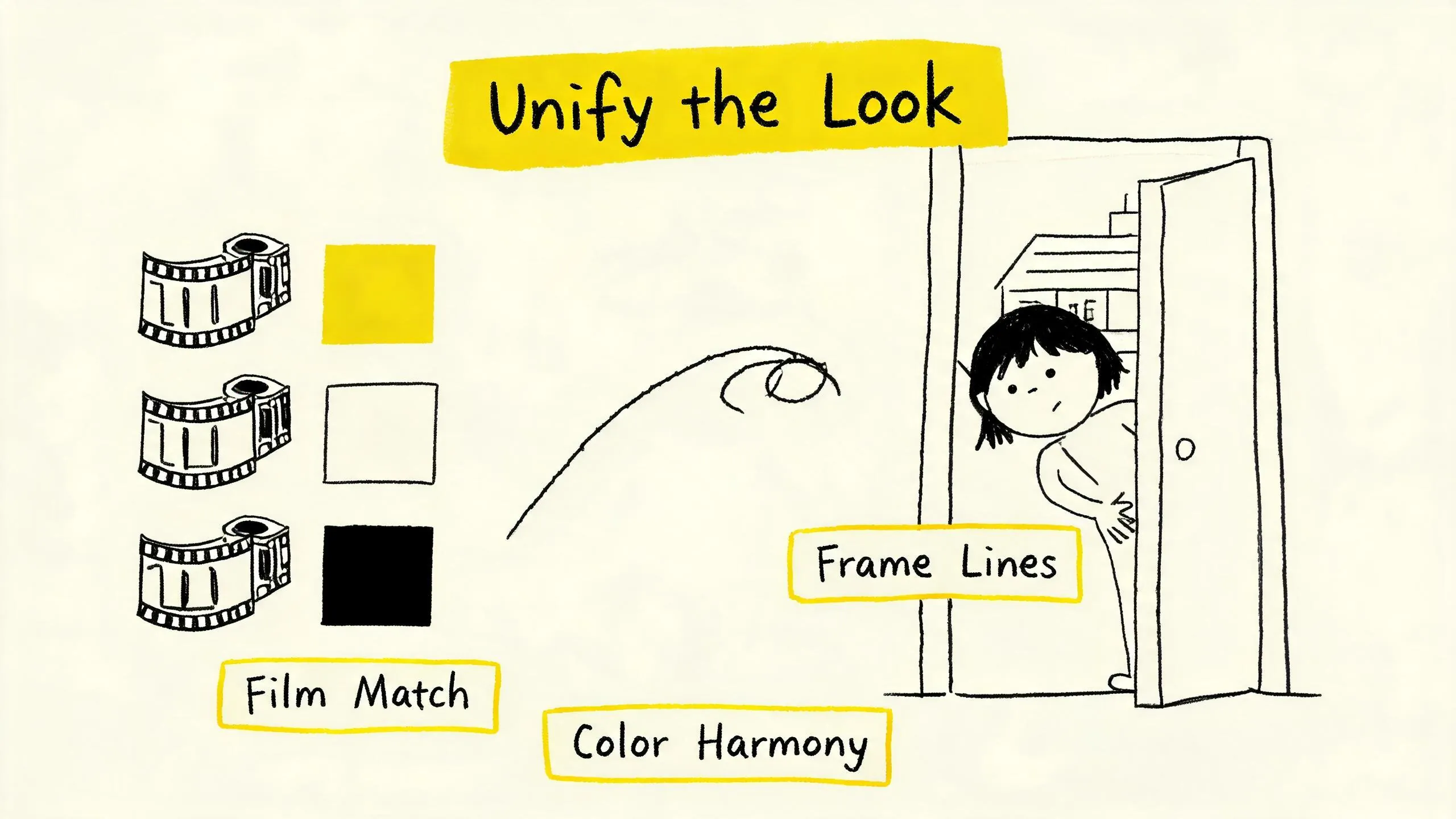
Matching Film Stock to Spatial Atmosphere
The color science, grain, and contrast characteristics of the film stock are the first step in shaping the spatial atmosphere.
- Bright, Open Neighborhoods / Modern Cities: Colorful negative films with moderate grain are a safe and excellent choice. For example, Kodak Ultramax 400 is widely considered suitable for general color recording in travel scenarios . It renders rich colors well in daylight, suitable for expressing a city’s vitality.
- Cities with Strong Classical/Historical Feel (e.g., European Old Towns, Domestic Ancient Towns): Black and white film can strip away the distraction of color, emphasizing architectural lines, layers of light and shadow, and historical weight. Photographer Art Meripol intentionally chose Kodak Plus X black and white film in Venice to “evoke the feeling of 19th-century European Grand Tour imagery, a sense of timelessness” . Finer-grained black and white stocks like Agfa APX 100 might be better suited for city architecture requiring rich tonal gradation .
- Abandoned/Industrial Spaces (Urbex): These spaces inherently carry an apocalyptic or nostalgic atmosphere. Some films with unique color casts can enhance this feeling. For example, HARMAN RED 125 film, with its unique red-sensitive characteristics, is used by photographers to shoot abandoned spaces; its “retro, blurry, raw aesthetic” perfectly matches Urban Exploration (Urbex) photography .
Key Principle: Understand the “character” of your chosen film stock in advance and consider whether it matches the temperament of the space you plan to shoot. If you’re pursuing a timeless, serene classical feel but use a roll of extremely vibrant cinema film, it might create a sense of dissonance.
Compositional Unity: Frames, Lines, and Repeating Patterns
In actual shooting, consciously employing certain compositional techniques can greatly enhance the unity of the entire roll.
- Frame Within a Frame: Use door frames, window frames, archways, tree branches, etc., as foreground frames to shoot distant scenes. This not only adds depth and layers to the image but, if used consistently, becomes a strong visual style.
- Leading Lines: Use lines formed by streets, rivers, railings, building edges, etc., to guide the viewer’s eye deep into the frame. In linear spatial narratives, the leading lines themselves become part of the narrative.
- Repetition and Pattern: Actively seek out and shoot repeating elements within the space, such as a row of identical windows, a wall built with repeating bricks, regular patterns of light and shadow on the ground. When these photos are juxtaposed, they create a strong sense of rhythm and formal beauty.
Color Control: Keeping Tones Consistent Across Different Spaces
Besides the inherent color tendency of the film stock, you can also control the tone through observation during shooting and post-processing/scanning.
- Identify Dominant Colors in the Environment: Before shooting, observe what the dominant color tone of the space is. Is it the brick red or gray-white of an old town? Or the glass blue or metallic silver of a modern commercial district? Consciously capture these dominant colors, letting them recur in different frames.
- Utilize Similar Lighting Conditions: Try to complete most shooting under similar lighting conditions (e.g., all overcast diffused light, or all dusk side light). This ensures the color temperature and light/shadow texture of the entire roll remain relatively consistent.
- Unified Scanning/Post-Processing Style: After the film is developed, choose a lab with a stable style, or establish a consistent set of color and contrast adjustment presets when scanning yourself. This is the final, and crucial, step in ensuring the final images have a unified tone.
V. Practical Cases: Three Rolls, Three Narratives
Let’s look at how spatial narrative is implemented through a few fictional but logically sound creative cases.
Case 1: 24 Hours in an Old Town (Timeline Narrative)
- Space: The historical core of a city, covering about one square kilometer.
- Film Stock: One roll of Kodak Portra 400, whose soft colors and skin tone rendering are suitable for recording humanistic atmosphere.
- Planning: Radial Narrative structure, with the central square as the origin. Shooting time from 6 AM to 10 PM.
- Narrative:
- Opening (1-6): Dawn, empty cobblestone streets, smoke rising from a breakfast shop, the first ray of sunlight hitting the clock tower.
- Development (7-28): Morning, the market gradually awakens, vendors setting up, elders reading newspapers; Afternoon, more tourists, cafes full outside, light and shadow moving between buildings; Evening, children after school, commuters, lights turning on in homes. Interspersed with architectural details, shop signs, close-ups of doors and windows.
- Closing (29-36): Night falls, neon lights turn on, the streets become quiet again, but the atmosphere differs from dawn—more serene and warm. The final shot could be a lone lamp in the square.
- Unity: Achieved through the consistent soft tones of Portra 400 and recurring visual motifs like “doors,” “windows,” and “light and shadow” throughout the day.
Case 2: City Slices Connected by a Subway Line (Linear Spatial Narrative)
- Space: A subway line running through different city zones (e.g., from suburbs to city center to industrial area).
- Film Stock: One roll of Ilford HP5+ 400 black and white film. Its high sensitivity and latitude are suitable for handling complex lighting inside and outside the subway, and black and white strengthens the contrast in structure and texture between different zones.
- Planning: Linear Narrative structure. Choose 5-6 representative subway stations and their surrounding 500-meter radius as shooting points.
- Narrative:
- Opening (1-6): The starting station, perhaps an open suburban view, the design of the station itself.
- Development (7-28): As the train moves, record the scenery outside different stations: residential areas, commercial streets, university towns, old industrial zones, financial centers. Focus on station interior structures, scenes at exits, and the most representative architectural or humanistic details of each area. Alternate between people inside the carriage and scenery outside the window.
- Closing (29-36): The terminal station, possibly a symbolic location (like a port, a large park). Or, the final shot returns inside the carriage, capturing an empty platform at the terminal station.
- Unity: The subway line itself is a powerful linear thread. The black and white tone unifies the lighting differences from bright outdoors to dim underground, strengthening the morphological contrast between different zones.
Case 3: Urban Memory in the Contrast of Old and New Architecture (Contrast Spatial Narrative)
- Space: An area in a rapidly developing city where old and new architecture coexist.
- Film Stock: One roll of Fujifilm C200 or similar daylight-balanced color negative film, whose color style might carry a nostalgic feel, suitable for expressing the dialogue between old and new.
- Planning: Contrast Narrative structure. Mark at least 3 sets of old vs. new architectural contrast points on the map (e.g., old church vs. new shopping mall; hutong vs. skyscraper; old factory converted creative park vs. new glass curtain wall office building).
- Narrative:
- Opening (1-6): A set of strong panoramic contrasts between old and new, directly stating the theme.
- Development (7-28): Alternately dive deep into the old and new spaces. Shoot the brick textures, carved details, and traces of time on old buildings; immediately follow with the smooth surfaces, geometric lines, and reflective materials of new buildings. Also capture interesting scenes of their coexistence, like a new building reflected in an old building’s glass, or people active at the junction of old and new.
- Closing (29-36): Could be a composition framing both old and new buildings in one shot, or a photo focusing on “people”—an elderly person sitting on a bench under a new building, symbolizing the flow and continuity of time.
- Unity: Achieved through the film’s slightly retro color style and the core concept of “contrast” itself. In composition, you can deliberately use similar angles or frames when shooting old and new buildings to strengthen the contrast effect.
Conclusion: From “Taking Photos” to “Building an Archive”
Using spatial narrative to unify a roll of film is essentially a shift from passive recording to active construction. It requires you to think about structure like a writer, design scenes like a director, and observe details like a scholar. This process may require more upfront investment than spontaneous shooting, but the reward is immense: what you gain is not just a roll of photos, but a visual urban archive imbued with your personal perspective and emotional warmth.
It records not only the appearance of a space but also the unique dialogue you had with that space at a specific time. Next time you pick up your camera and load a roll of film, try selecting a space for it—whether a familiar corner of your city or a charming neighborhood discovered by chance on a journey. Use the limitation of 36 frames to force yourself to observe deeply, use a planned route to connect fragments, and use a unified tone to coalesce emotion. You will find that when this roll is developed, what unfolds before your eyes is a unique city, “written” by your own hand.